


Please click here to opt in to receive via email our Roundup—brief daily summaries of news developments and commentary related to executive power.
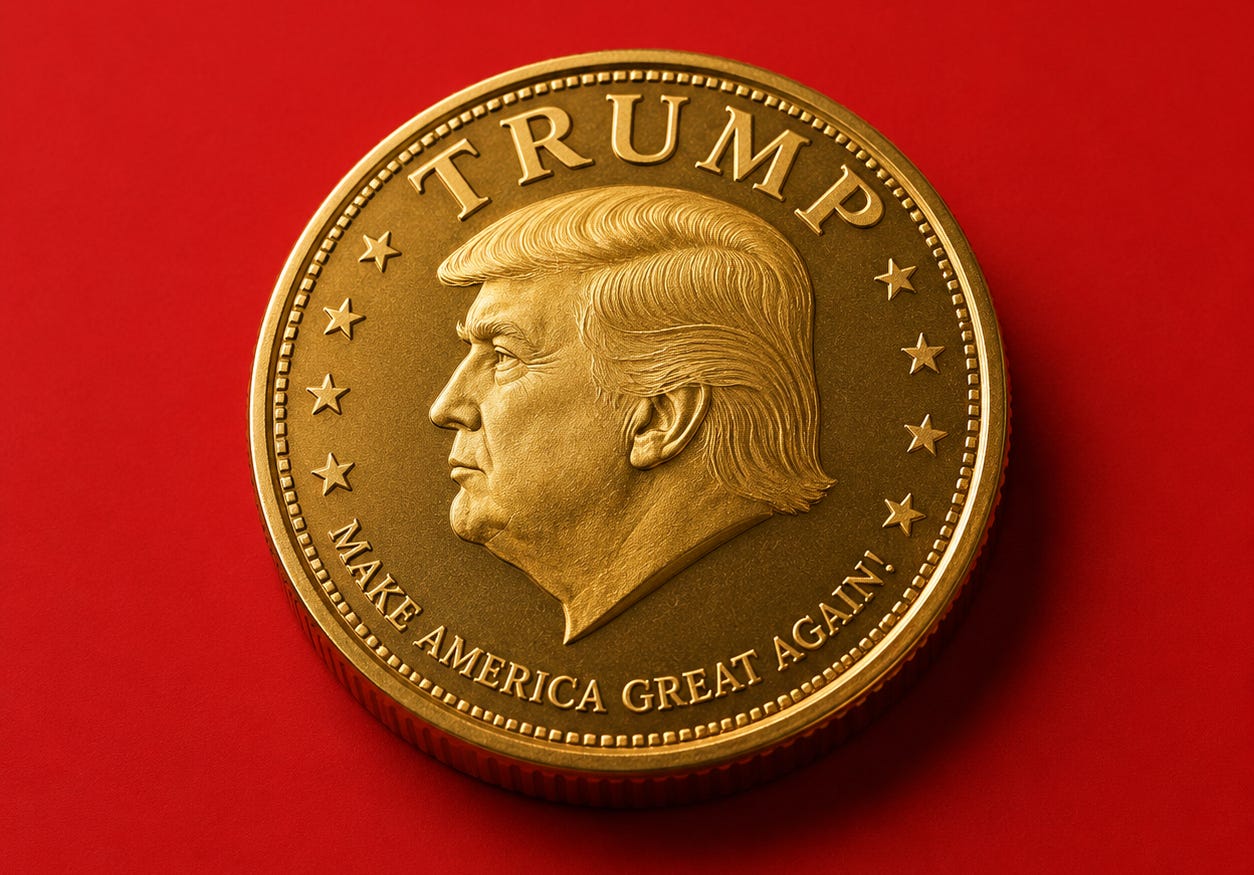
As surprising as it may seem, the Senate is actively considering a measure to subject the president of the United States to new conflict-of-interest regulation. The reform under consideration is not comprehensive: It would constrain the president only in the “issuance” or “sponsorship” of specific digital assets, such as the $TRUMP meme coin that he has energetically promoted. The proposed regulation would be included within the Clarity Act, a complicated bill to reform the regulatory framework for the cryptocurrency markets.
As presidents are generally exempt from conflict-of-interest requirements binding on other executive branch officials, the prospect of some reform in this area may seem welcome. Trump is working with Senate Republicans on rules he can accept. The Republican leadership is touting his cooperation: A Banking subcommittee release declares that “no president in American history has voluntarily agreed to self-imposed, substantive ethics limits like President Trump has” in the development of this proposal. Democrats (and at least one Republican, Sen. Thom Tillis) have criticized the current draft, but discussions between the parties are expected to continue. What is surely driving Republicans to seek common ground is the unprecedented and highly controversial sum—a reported $1.4 billion—that the president earned from his crypto-industry business interests and pursuits in 2025 alone.
The question is whether any deal on the model of the current proposal is better than none. The answer turns, of course, on the shape and specific language of the final agreement, if reached. The details will matter. However, so will the overall approach to presidential conflict of interest that these details have been fashioned to support. In this respect, the version now under discussion is, to understate the point, bad. It focuses exclusively on, but does not seriously address, a particular “digital assets” conflict-of-interest issue, while effectively blessing the more basic conflict problem across the full range of this president’s multibillion-dollar business pursuits.
In only summary terms, this is the basic structure of the proposal now on the table:
A public official, including a president, could not issue or sponsor, in exchange for consideration, a specific digital asset. Under the bill, the sponsorship of an asset includes expressly promoting it, or permitting “the use of the official’s name, likeness, office, or official position in connection with the creation, launch, or express promotion [of the asset].” A violation would subject the official to the disgorgement of profits and civil penalties through enforcement action by the attorney general. An asset issued or sponsored in violation of the statute could not be listed on any exchange. Moreover, other statutes, such as the Securities Exchange and Commodity Exchange Acts, would still apply to market manipulations or fraud along with the criminal penalties those laws provide for. The personal financial disclosure law for public officials would be amended to provide for a new category of reporting of “digital assets that are sold for remuneration.”
As noted below, the bill provides for expansive allowances and loopholes. The Republican majority has nonetheless been advertising the core framework as a “first-of-its-kind ban” that proves that “clean government and pro-innovation policy are not opposites.” The bill is carefully built around the proposition that this is a one-time voluntary submission by Trump to “a higher standard than the law required of him”—a “standard President Trump chose to hold himself to, not one Congress imposed on him.”
This is the oddest of constructs for any presidential conflict-of-interest reform. It applies only, and with significant exceptions, to the creation or promotion of a specific asset, and only for the balance of this president’s term. Sen. Cynthia Lummis of Wyoming, who is managing this effort for the Republican side of the aisle, claims that this is not “legislation around one person who holds one office for the next two years,” but the bill as written belies that assertion. Consider on this point the bill’s sunset provision. The proposed ethics requirements expire on Jan. 20, 2029, and the sunset provision expressly insulates the public officials (or any other person within its scope) from liability after the sunset date for conduct that may have violated the law when it was in effect. And the bill’s ethics requirements do not become effective upon enactment. Rather, they take effect only after a delayed implementation period that may extend to 360 days after enactment. Also peculiar is the sponsors’ position that these requirements are the product of a “voluntary” agreement by the president and not rules “imposed” by Congress.
The measure as proposed is further written to lighten the bill’s burden on Trump’s crypto business pursuits even for the remaining years that he is in office. The prohibition on issuance or sponsorship applies to the officials and their spouses, not to family members, such as the Trump sons, who have managed his business interests throughout his presidencies. The president would not be liable in the event of “third-party” uses if he did not “authorize, direct, coerce, exercise control over, or coordinate” those uses with that third party, and his sons would qualify as third parties for purposes of this provision.
Moreover, persons other than the president or his spouse can continue to use his name, likeness, or image in issuing or sponsoring new digital assets, provided that the president divests of any “direct interest” in the asset, or places it in a “qualified blind trust” as defined by law. I will not address here what would constitute a “direct interest” except to note that the law also empowers the Office of Government Ethics to provide “interpretive guidance” on this and other provisions of the act. There’s the rub: Trump has defanged the OGE, and he controls it and any interpretive choices that it makes. And there is still more room in the bill for the president’s direct personal promotion of digital assets with benefits for his own holdings. The bill does not prohibit Trump from “appearing at an event paid for or organized by a person that issues or sponsors a digital asset or encouraging the use of digital assets generally.”
Another, deeper problem with the bill is its adoption of the narrowest of views of what constitutes a conflict of interest in a president’s conduct of his official duties. The law permits the president to hold digital assets as “investment[s],” subject to “conflict-of-interest requirements as otherwise provided by law.” Few such requirements apply to presidents. At the same time that the president maintains his investments, he may make public statements and take official actions that have a major impact on their value. The law reflects the view that this intersection of personal interest and public policy does not present conflict-of-interest issues. The bill is clear on this point: It identifies, among other “safe harbors,” from the application of its proscriptions, “official actions and duties,” and it specifies that a president is not prohibited from 1) “making any statement or taking an official government action on digital asset policy, digital asset legislation, or digital asset regulation, in the exercise of official duties” or 2) “making any statement regarding digital assets that is not made in expectation of receiving consideration.”
The proviso that statements made “regarding digital assets” cannot be made in “expectation of receiving consideration” has little force. It sets up a subjective test—an “expectation”—that would be very difficult for an enforcing authority to satisfy.
Taken all together, the various provisions that make up this proposal validate a presidential conflict-of-interest regulatory scheme that allows for lucrative presidential business pursuits while in office—the value of which would be necessarily influenced by his exercise of his official duties. It is consistent with Trump’s own view that “The law’s totally on my side, meaning, the president can’t have a conflict of interest,” that is, in the elemental sense that no conflict arises when a president can take action with predictable, significant effects on his personal finances. The bill embraces this perspective, focusing only on specific actions involving “a specific digital asset,” but, even at this level, taking care to minimize adverse impact on this aspect of the president’s business interests.
Even if some of the loopholes and allowances are closed or tightened, this bill—the basic framework it establishes—is the wrong path to conflict-of-interest regulation in response to this president’s amassing of billions of dollars of wealth in the course of this second term. Rather than acceding to the president’s view of his prerogatives, Congress could assert and defend its own. It could decline to pass the pending “specific digital assets” ethics bill as it is now structured, and then, when the opportunity arises in the years ahead, write serious reform legislation. Any such reform would bring presidents within the zone of current conflict-of-interest regulation of other federal elected officials for all of their business interests. The right approach would also be the most straightforward and would include meaningful financial disclosure and blind trust requirements, and strengthened enforcement of the Foreign Emoluments Clause.
