


Please click here to opt in to receive via email our Roundup—brief daily summaries of news developments and commentary related to executive power.
One year ago today, we started Executive Functions. It has been a rewarding journey. We are grateful for our readership.
In our first post, we wrote: “President Trump’s pledges to cast aside many norms and to test many foundational laws governing the presidency hold the potential for a major transformation of the Office.” One year, 79 posts, and 35 chats later, we offer a high-level, and inevitably selective, assessment of Trump efforts to redefine executive power.
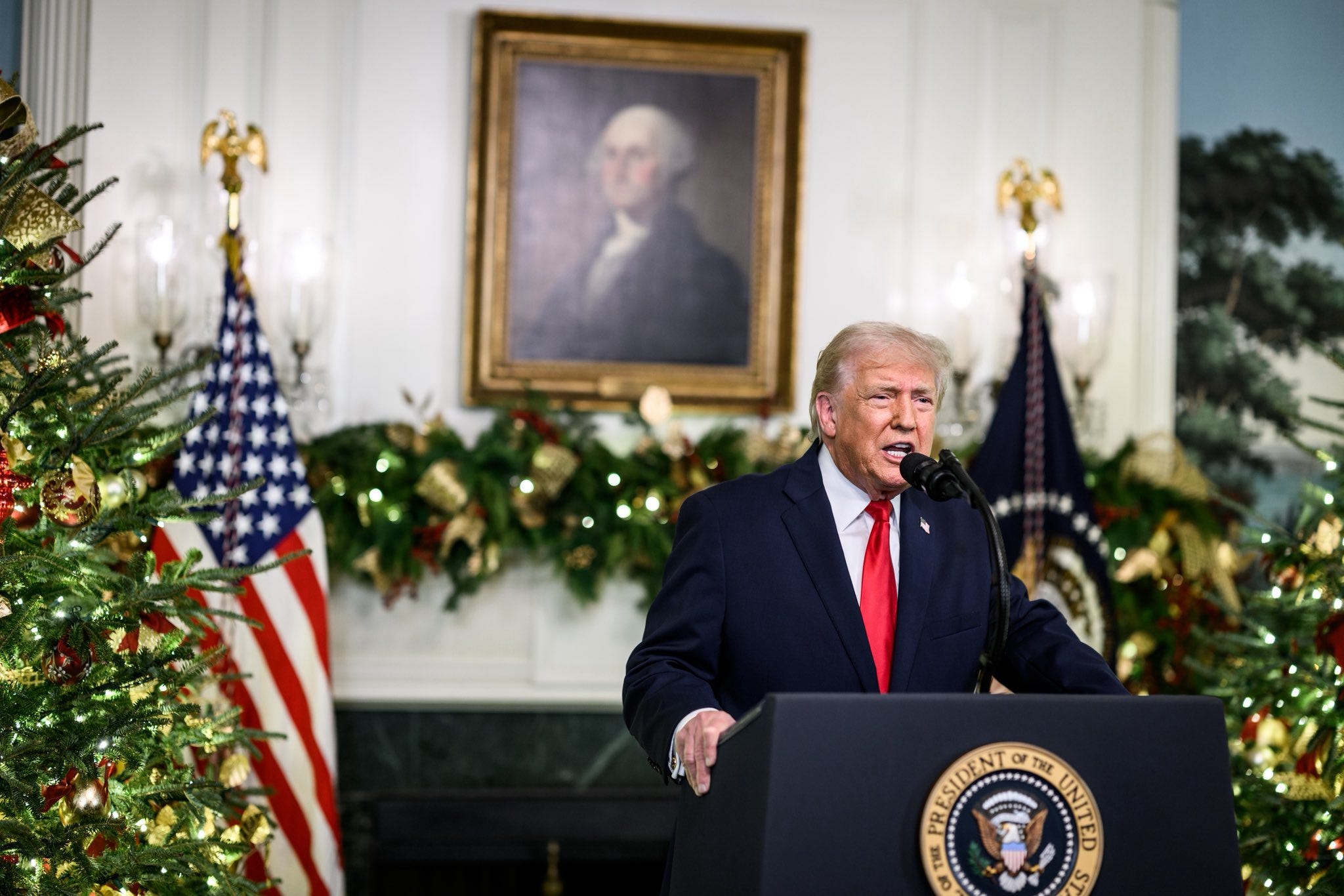
President Trump’s combative speech last night frames the analysis. He claimed that his administration has “brought more positive change to Washington than any administration in American history.” In the pursuit of this agenda, Trump has unquestionably expanded presidential power in important ways. But whatever other successes he may tout, his administration is not on a clear path to “radical” constitutional change.
Vertical Control
Trump’s central achievement has been to establish unprecedented vertical control over the executive branch.
He has imposed his legal will on the executive branch like no previous president. The keys have been formal directives; senior lawyers who previously served as the president’s personal counsel (including the attorney general, the solicitor general, and the White House counsel); strict loyalty tests; and hair-trigger firings for deviations.
Backed by a decade of Supreme Court precedents, Trump has also successfully asserted Article II power to fire executive-branch officials, including members of agencies traditionally insulated by for-cause protections. The Supreme Court in interim orders provisionally upheld several Trump agency firings and recently heard oral arguments in Trump v. Slaughter, which squarely raises the president’s power to remove heads of multimember agencies despite statutory protections. Trump is expected to win this important case, but the depth of the president’s Article II firing power will depend on how the Court writes its opinion.
The Trump administration has also claimed statutory authority to fire or cause voluntary separation of all manner of civil servants—212,840 as of Dec. 16. It is unclear what percentage of these actions are lawful, and the Supreme Court has thus far avoided direct engagement with the president’s statutory arguments. And yet Trump has demonstrated to a far greater degree than any modern president that the “civil service . . . is not insulated from politics,” as Nick Bednar put it.
Trump has also manipulated statutory mechanisms and disregarded norms to condition, delay, cancel, or otherwise disrupt federal obligations and expenditures. Here too it is unclear here how much of this is lawful, and Supreme Court interim orders on such issues have focused primarily on who can sue and where. Yet even these procedural rulings have given the president a large advantage in restructuring the executive branch.
These tools converged in the Department of Government Efficiency (DOGE), the impact of which remains unclear. Yet independent of the DOGE framework and acknowledging that many legal issues related to civil service firings and appropriations gambits remain unsettled, the Trump 2.0 innovations have been consequential. They have enabled the administration, for example, to hollow out U.S.A.I.D.; to shrink the Department of Education; and to wipe out important department components, such as the Justice Department’s Civil Rights Division.
Trump’s vertical control toolkit will outlive his presidency. Just as the Clinton administration reworked the unitary executive innovations of the Reagan and first Bush administrations, and just as President Biden in 2021 used unitary executive precedents to fire Trump 1.0 agency officials (including ones with statutory protections), future Democratic presidents can be expected to adapt these innovations for very different agendas.
Weaponization
Trump has used the tools of vertical control to do harm to perceived political enemies. Trump is not the first president to weaponize the presidency. But he has done so on an incomparable scale.
First, as a Reuters study documents, a good number of the removals were motivated by retribution.
Second, termination of agency members facilitates weaponization. Trump’s February removal of Merit Systems Protection Board (MSPB) member Cathy Harris, combined with the expiration of another member’s term on Feb. 28, denied the Board a quorum. This left it unable to issue decisions in challenges to civil service firings until the Senate confirmed a new MSPB member in October. And, of course, the president’s power to fire MSPB members carries the power to influence their decisions.
Third, executive orders and related directives facilitated other forms of weaponization. Good examples are the executive orders against law firms and the funding freezes and actions against universities. Courts have ruled these initiatives unlawful and the Justice Department has slow-walked appeals. These initiatives have nonetheless brought some law firms and universities to heel and chilled others from acting contrary to administration wishes.
The future of the weaponized presidency is hard to predict. But every presidency after Trump’s will learn from his extreme and, in many respects, novel forms of weaponization.
White House Control Over Law Enforcement
Trump v. United States broadly affirmed the president’s law enforcement discretion and control over the Justice Department. Trump has used this power in notable ways.
Unlike in Trump 1.0, the norm of Justice Department independence is dead in Trump 2.0. Trump regularly directs Justice Department actions, including retributive prosecutions of perceived enemies such as New York Attorney General Letitia James and former FBI Director James Comey—yet another form of weaponization.
Trump has also staked out unprecedented discretion to not enforce civil law. As Zachary Price documented over a decade ago, “executive policymaking through nonenforcement stretches back across recent administrations.” But Trump’s nonenforcement of the TikTok ban has reached new heights. The administration gestured to the ban’s foreign affairs context but at bottom asserted a simple power to not enforce a law it dislikes. It also proclaimed that private firms could not face liability for violating the ban—a clear example of the dispensing power that the framers sought to deny the president and that the Supreme Court has ruled unlawful.
Absent unexpected Supreme Court intervention, presidential law enforcement discretion will emerge from Trump 2.0 enhanced.
The Pardon Power
Presidents have long used the pardon power for political or personal ends. Trump 1.0 pushed this practice to unprecedented lengths. Trump 2.0 is going further.
Trump gave clemency to everyone convicted in connection with the Jan. 6, 2021 attack on the Capitol. He pardoned 77 people, including close allies, who were involved in the 2020 election denial scheme. He pardoned numerous officials convicted of public corruption crimes and dozens of people convicted of financial crimes, including in circumstances that seemed to benefit the Trump family, and he pardoned convicted large-scale drug dealers, most notably Honduran President Juan Orlando Hernández. Trump’s “industrial-scale pardon business” appears to be fueled by cash to Trump interests and acquaintances.
The flow of pardons will surely continue. And Trump will likely issue hundreds of preemptive pardons near the end of his term to those plausibly exposed to federal investigation by a successor administration.
The War with the Media
We wrote in 2020 that “Trump exceeds all predecessors” in his verbal attacks on the press and restrictions on White House press access. In Trump 2.0, the president has vastly escalated his assaults on the press.
One instrument has been personal lawsuits against the press. Allegations include defamation claims, electoral interference, and a politically damaging edit of an interview with his 2024 general election opponent. Trump settled the cases involving ABC and CBS for a combined $31 million. This week, he filed a $10 billion lawsuit against the BBC for its editing of his Jan. 6 National Mall speech.
While Trump brought these cases in his personal capacity, the settlements and other impacts are informed by Trump’s power as president. In the CBS settlement, for example, parent company Paramount’s business interests were at stake in a merger pending federal regulatory approval.
The administration has also expanded Trump 1.0 restrictions. It barred the Associated Press from Oval Office press pools and exchanges after it declined to follow the president in renaming the Gulf of Mexico as the Gulf of America. In October, the Pentagon announced that it would condition eligibility for press credentials on what news organizations understood to be an agreement, in effect, to not solicit or report on any information that hasn’t been authorized for public release.
It is unclear how the lawsuits and banishments will shake out. While measuring the deterrent effect on the press overall is impossible, the lawsuits inflict financial pain and may in some cases threaten their parent or affiliated company business interests, even if they are legal losers. The remarkable settlements indicate that at least some elements of the media—or their corporate owners—care enough to sacrifice what used to be cherished First Amendment principles.
The Business Model Presidency
Trump and his family have raked it in since January— “at least $4 billion in proceeds and paper wealth for the family as of December” of this year, as reported by the Wall Street Journal. When the Financial Times asked if its estimate—more than $1 billion in pre-tax profits from crypto ventures alone—was correct, Eric Trump replied: “probably more.”
The Trump family has pursued its crypto interests in a manner that present obvious conflict of interest issues. Under the umbrella of Trump Organization affiliates, Trump launched the $TRUMP meme coin just days before inauguration and later used personal appearances and a White House tour to stoke investor interest. His reported personal profit exceeded $300 million, and the press reported significant overseas investor participation. The porous Trump Organization conflict-of-interest policy did not bar this activity, and it is not clear that another primary Trump family vehicle for pursuing this crypto interest, World Liberty Financial (WLF), is a party to that or any other such policy.
These crypto ventures have coincided with pro-crypto policy, regulatory support, and pardons for prominent industry figures. They have also overlapped with major foreign policy decisions, including the sale of advanced computer chips to the United Arab Emirates around the time that the UAE made a major investment in WLF tokens.
The entanglement of administration policy and family business is also evident in Jared Kushner’s role in U.S. foreign policy. Trump’s son-in-law led sensitive negotiations in the Israel-Gaza conflict yet also runs a private equity fund with backing by Qatar, Saudi Arabia, and the UAE.
These are among the many examples of what Bob earlier described as a transactional “business model” president who shapes policy through dealmaking while he and his family take their cuts. Trump has facilitated self-dealing by removing internal checks that might constrain it. In his second term, he fired the Director of the Office of Government Ethics (OGE), which has guided past presidents on conflict-of-interest issues. He then installed acting directors drawn from the Executive Office of the President that effectively subordinated OGE to the White House.
Trump’s business model presidency has thus far avoided politically debilitating scandal. But his vulnerability surely will increase over the next three years if he and his family continue to amass vast wealth during a period of economic discontent.
Military and Foreign Affairs
Presidents usually get their way in military and foreign affairs contexts, where Congress legislates broadly: Article II is often implicated, and courts are typically deferential. Yet the president’s record in this context is surprisingly mixed.
Trump’s boat strike campaign is a significant expansion of the Article II power to use military force against private actors. The congressional response remains uncertain. The House Armed Services Committee closed its investigation but included a provision in the recently passed National Defense Authorization Act to pressure the administration to release the unedited footage of the Sept. 2 double-tap strike, and the Senate Armed Services investigation into that strike continues. No one has sued to enjoin the boat strike campaign, and any such suit would be futile.
Trump has also had some success in deportation cases. The Supreme Court in interim orders allowed the administration to end Temporary Protected Status for Venezuelan nationals, to revoke parole and work authorizations previously granted to noncitizens from four countries, and to continue aggressive ICE detentive stops. But the Court in a May interim order also gave the administration a stinging defeat in its Alien Enemies Act summary removal efforts, which remain enjoined.
The administration lost a big case on its asylum ban in a persuasive opinion by Judge Randolph Moss from which the administration did not seek interim relief. Its efforts to expand fast-track deportation efforts have been overwhelmingly rejected by hundreds of lower court judges. And a judge last week ordered the release of Kilmar Abrego-Garcia in what Andy McCarthy at the National Review accurately describes as an “astonishingly ill-considered case.”
The president also asserted sweeping tariff authority under the International Emergency Economic Powers Act. The administration lost in the lower courts and faced a tough time at oral argument in the Supreme Court. The outcome on this signature issue remains uncertain.
Finally, the administration’s domestic National Guard deployments have not gone well. The L.A. deployment was allowed to continue by the Ninth Circuit over the summer but last week was enjoined on new grounds by a federal district court. The Portland deployment is currently enjoined and on interim review before an en banc panel of the Ninth Circuit. The Chicago deployment is also enjoined; the government’s Oct. 17 application for interim relief before the Supreme Court is still pending. The District of Columbia deployment, where the president has strong legal authorities since he is commander in chief of the District’s National Guard, was initially enjoined as well, though that injunction is stayed pending appeal.
Conclusion
The first eleven months of the second Trump administration might appear to have radically changed the presidency and its place in American government and society. Trump issued one muscular executive order after another, prevailed in a high percentage of Supreme Court interim orders, put opponents everywhere on their heels, and seemed to have his way far more often than not in implementing his agenda.
The record to us seems more mixed. Trump has definitely achieved some of his policy aims—for example, slowing the flow of unlawful immigrants, shrinking the government, cutting taxes, imposing tariffs (for now), and turbocharging crypto and AI.
But Trump 2.0’s impact on the presidency itself remains uncertain. Trump has been most consequential in creating a more-unitary-than-ever executive with much more power to incapacitate disliked parts of the government than previously realized. He has also shown what a fully weaponized presidency looks like and how consequential it can be even if it loses in court. And while other presidents have abused the pardon power, none have done so like Trump.
And yet other aspects of the Trump program seem fragile. Trump has to an unusual degree relied on unilateral presidential action rather than securing new powers from Congress. The Big Beautiful Bill included massive new resources for ICE but did nothing to fix the statutory removal authority restraints that have been gumming up Trump’s deportation efforts. Nor did Trump seek to put his tariff authority on a firmer statutory footing. He is rolling the dice that the Supreme Court will bless his unilateralism in these and many other contexts. But as Sarah Isgur argued, a Court on board for the unitary executive might not be on board for presidential initiatives based on questionable claims of congressional authorization.
It is important to remember that Trump’s winning record on the interim order docket represents only a fraction of the cases against him and involve issues the solicitor general believed the government had a good chance to win. The government remains subject to dozens of lower court injunctions implicating a wide swath of its program.
We are in the early innings of judicial review of Trump 2.0, and it is not at all clear where matters beyond the unitary control issues the Court has long favored will end up. If the Court rules against the administration on most or all of (i) the tariff case, (ii) the birthright citizenship matter, (iii) the Alien Enemies Act litigation, and (iv) the Federal Reserve “for-cause” case, Trump’s “radical constitutionalism” will look less menacing and less reconstructive.
There are also signs that Trump’s dominance over Congress is ebbing—a trend that will continue as mid-terms approach and members’ political fortunes are increasingly at risk. Second-term presidents accomplish most of what they can hope to do in the first 18 months; Trump’s ability to get helpful legislation from Congress, at least beyond the annual National Defense Authorization Act (NDAA), will decrease in the next three years. And his relationship with Congress on the oversight front will not get easier from here either.
Trump dominates the messaging space like no prior president, and the flurry of words and paper can seem like accomplishments in themselves. But they are not. Trump has definitely changed the presidency and the country. But not yet as much as it seems to many.
