


Please click here to opt in to receive via email our Roundup—brief daily summaries of news developments and commentary related to executive power.
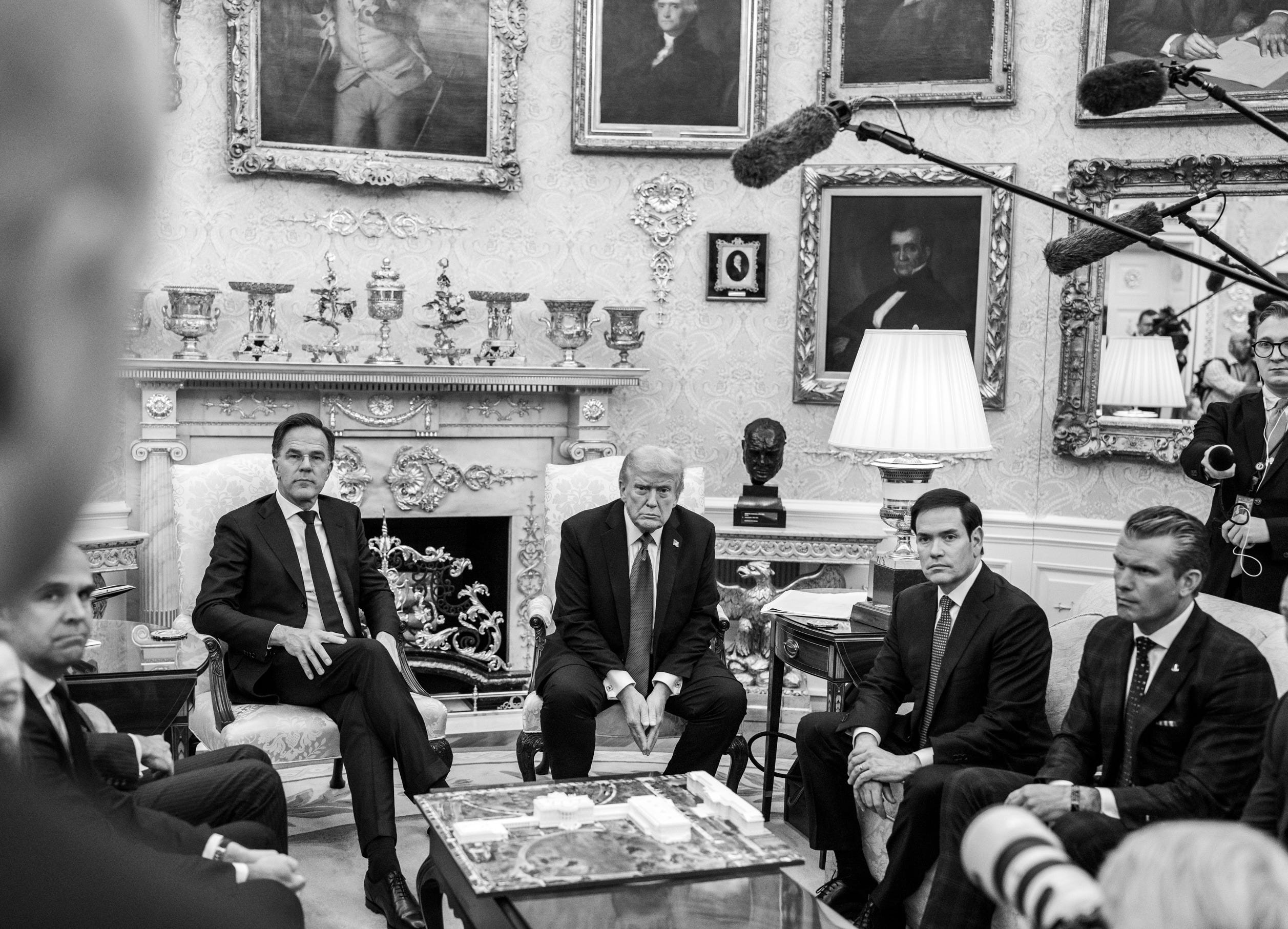
Donald Trump started his war with Iran on Feb. 28. He didn’t notify Congress or ask its permission and didn’t consult with it much thereafter. (Nor has Congress appropriated funds specifically for the Iran conflict.) Trump conducted the war as he wished—along the way committing strategic blunders made worse by empty threats and embarrassing claims of victory.
And now Trump purports to have reached a “Great Deal” with Iran that “will bring Peace and Security to the whole Region.” The deal is apparently embodied in a 1.5 page “memorandum of understanding” that is, according to Vice President Vance, a “very general document.” As of this writing the text is not public but based on many reports it does not obviously improve the U.S. position from the baseline of Feb. 28.1 Along the way Trump damaged the American and global economy, as well as America’s military and diplomatic standing.
This process is not what the framers had in mind. The Constitution placed democratic constraints on presidential war and foreign policy decisions to ensure that an incompetent or corrupt president could not easily make very bad international choices on the nation’s behalf.
These constraints have almost entirely disappeared. And that disappearance has enabled Trump, with practically no congressional input, to entirely reinvent U.S. foreign policy and relationships and to reorder global institutions.
There is little that is brand new in the current president’s claims to constitutional and statutory war and foreign relations power. But Trump has used these powers with unprecedented boldness, on an unprecedented scale, with unprecedented disregard for Congress.
The Iran adventure is the latest instance of the “one person decides” principle of U.S. foreign policy that Trump has taken to new extremes, and that undeservedly has received less critical attention than Trump’s domestic unilateralism.
***
The control over war-initiation that the framers thought they gave Congress—mainly in the Declare War Clause and the power over appropriations—has devolved into a dim power to stop presidential war if Congress can overcome a presidential veto. Congress has more leverage if and when a president needs supplemental funding to continue a war—something Trump has not yet sought with Iran.
The check on international agreements embodied in the Senate consent requirement to treaties has been practically eliminated—first by the rise and rise of “executive agreements,” which have some constitutional and statutory constraints, and then by the rise and rise of presidential nonbinding agreements, which have no real constitutional constraints and only very selective and undemanding statutory ones.
In addition to having broad power to make international agreements, presidents also have broad power to abrogate them. And the president’s power over diplomacy has seen “runaway” growth in recent decades.
Congress’s diminished role in war and foreign policy has resulted in part from presidential constitutional arrogation and in part from long-term congressional abandonment and delegation. The trend did not begin with Donald Trump. It began with George Washington and has continued steadily, with blips, for nearly 240 years.
But Trump has taken presidential war and foreign affairs unilateralism to new levels. In this context more than in domestic affairs, where bureaucratic process and pesky courts play a bigger role, Trump can more readily execute his mercurial will. He clearly likes that.
Trump last year bombed Iran’s nuclear sites and then this year began a larger-scale war, the second most consequential unilateral use of force in American history. He invaded Venezuela, deposed its leader, and is now, apparently, indirectly running the country. He has conducted dozens of military attacks on alleged drug runners in the waters off South America. He has also used force in Nigeria, Somalia, Syria, Iraq, and Yemen and has threatened to use force in Greenland, Mexico, Oman, Cuba, Panama, and, arguably, Colombia.
Majorities in Congress voted against the Iran adventure but failed to stop it and Congress has done nothing of substance on the other war matters.
Trump has taken a wrecking ball to international agreements and institutions without any involvement by Congress. He killed many agreements in his first term—most notably, the Obama-era Joint Comprehensive Plan of Action with Iran (an agreement made without congressional consent). In his second term, Trump has withdrawn from the foundational U.N. Framework Convention on Climate Change, among other international agreements, and from scores of international organizations.
Most of these latter withdrawals were part of a larger effort to delegitimize a fundamental international treaty organization—the United Nations. In addition to broad withdrawal from U.N. treaties and bodies, and to many violations of the U.N. Charter, Trump has sought to starve the U.N. (including its organizations and peacekeepers) of funds, and to gut foreign aid more broadly, not to mention USAID—though in some of these contexts Congress pushed back a bit. And he established the Board of Peace as a workaround or alternative to the United Nations.
Trump has long threatened to withdraw from the North Atlantic Treaty. This is a rare area where Congress has constrained a president from pursuing a foreign policy goal. I believe the constraint is lawful, though not everyone does. But it’s far from clear anyone can sue in federal court to enforce it.
And short of formally leaving NATO, Trump has taken steps to diminish the alliance—for example, withdrawing troops from Germany, threatening reductions elsewhere, delaying deployment to Poland, and casting doubt on whether the United States would defend NATO countries if attacked. He has also altered U.S. policy towards Ukraine. These moves and threats are within the president’s discretion.
And then there is Taiwan. The long-term U.S. policy—wrapped in formal strategic ambiguity—has been to preserve democratic Taiwan’s de facto autonomy through deterrence and the U.S. capacity to intervene. This policy is reflected in the Taiwan Relations Act and decades of presidential diplomacy.
Many worry that Trump will bargain away Taiwan for some larger deal with the People’s Republic of China. Trump could do this if he chose. The Taiwan Relations Act imposes an unenforceable duty on the president “to inform the Congress promptly” of any threat to Taiwan or U.S. interests arising from threats to Taiwan. It adds that the president and Congress shall together determine “appropriate action by the United States in response to any such danger.” But the president controls U.S. diplomacy, and it is ultimately his decision whether to defend Taiwan militarily.
Finally, President Trump, like all contemporary presidents, has aggressively used his many statutory emergency and sanctions powers.
***
Most of Trump’s actions are lawful under domestic law. Some may not be, though they build on presidential precedents of various sorts. Presidents often get away with even illegal actions in these contexts because Congress is feckless and courts—due to standing and the political question doctrine—often do not get involved.
There are, of course, counterexamples, especially when the president reads a statutory authority aggressively and someone has standing to sue. Trump’s big tariff loss a few months ago in Learning Resources is a good example.
But Trump was still able to have a huge global impact before the Court ruled, and he has continued many tariffs under other statutory authorities. And in any event, Learning Resources is an exception to the longstanding general rule that, as Harold Koh taught almost four decades ago, the president almost always wins in foreign affairs.
While Trump is exercising powers that presidents have in the round long exercised, in his hands the powers seem, and perhaps are, quite different. This is because Trump has exercised many of these powers on a much grander scale than his predecessors, often to depart sharply from what was previously a bipartisan foreign policy consensus. Trump has also displayed unusual disregard toward Congress—and Congress has done practically nothing about it. This pattern reflects the “separation of parties, not powers” enhanced by Trump’s unique retributive politics.
***
The democratic checks contemplated by the Constitution seek to ensure that U.S. foreign policy is generally stable, and that a president’s major foreign policy decisions conform to the national interest, or at least can withstand the scrutiny of democratic debate.
This system clearly no longer works. Congress has too little say in the conduct of foreign policy. It rarely legislates to shape that policy, as it once often did. It rarely uses its vital political weapons when a president engages in unwise foreign policy. Like them or not, there are no Senators Mansfield, Nunn, or McCain to provide firm and sometimes wise counterpoints to presidential foreign policy.
Extreme presidential unilateralism in war and foreign relations tends to produce bad consequences. One is that it is too easy for presidents to start wars.
Another is that U.S. foreign policy lacks coherence across short periods. When important foreign policies are the decisions of a president alone unmoored from presidency-transcending laws and agreements, or specific congressional consent, they tend to seesaw across presidencies.
Consider Iran’s nuclear weapons. President Obama sought to control them through sanctions and then diplomacy and a non-binding agreement. That agreement, the JCPOA, took 20 months of intensive negotiations. It lasted about two and a half years, at which time (in May 2018) Trump tore it up. President Biden tried but failed to put it back together. And now Trump in his second term chose to deploy fierce military force to curb Iran’s nuclear program.
Or consider the Paris Climate Agreement. Obama, again skirting a congressional vote, signed it on Aug. 29, 2016. Trump announced U.S. withdrawal in 2017, which went into effect in November 2020. Biden upon entering office in 2021 signed an executive order to rejoin the agreement. Trump on his first day in office in 2025 again announced the U.S. withdrawal, which went into effect in January 2026.
This basic back-and-forth pattern has also been repeated with respect to a number of international organizations (e.g. the World Health Organization and the U.N. Human Rights Council). There is every reason to expect it will continue if a Democrat wins the presidency in 2028.
U.S. foreign policy has never to my knowledge been unstable in these ways. The obvious consequence of this instability, beyond whatever bad policies result, is that U.S. foreign policies and commitments—formal and informal, legalized or not—are increasingly and foreseeably unreliable. That cannot be good news for fruitful U.S. relations with the rest of the world.
Thanks to Molly McCammon and Tia Sewell for editorial assistance

Congress may get a chance to review Trump’s Iran deal under the Iran Nuclear Agreement Review Act if the deal is “an agreement with Iran relating to the nuclear program of Iran.” But even if so, this would at most delay any contemplated sanctions relief for 60 days for Congress to review it. It would take supermajorities in both houses to kill the deal, which isn’t going to happen.