


Please click here to opt in to receive via email our Roundup—brief daily summaries of news developments and commentary related to executive power.
The FBI raid on the Fulton County election headquarters in Georgia, reportedly conducted in connection with the 2020 elections—and President Trump’s rhetoric immediately afterward about “nationalizing” the 2026 congressional elections—have intensified concerns about the administration’s readiness to intervene in unprecedented fashion in this year’s midterms. But this post calls attention to a development that, to my knowledge, has thus far escaped general attention: a Department of Justice action that may signal formal revision or reversal of the long-standing law enforcement policies favoring federal government restraint in election fraud investigations. To put it another way, the DOJ may be quietly preparing to adjust its law enforcement guidelines to more closely align with Trump’s view that “nationalization” is required to address widespread fraud.
The Uncertain Status of the Department’s Federal Prosecution of Election Offenses
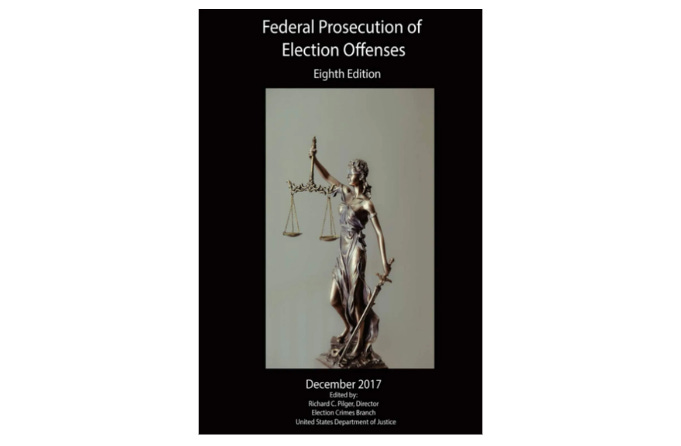
For many years, in both Democratic and Republican administrations, the Department of Justice has published a manual for its prosecutors entitled the Federal Prosecution of Election Offenses. It is now in an eighth edition, published in December 2017. It is a remarkable document—and it articulates principles of federal prosecution that the president is currently rejecting.
The manual embraces the basic principle that the federal government’s role in elections is “prosecution, not intervention.” It affirms that “[t]he principal responsibility for overseeing the election process rests with the states,” and that “[i]t is the states that have primary authority to ensure that only qualified individuals register and vote, that the polling process is conducted fairly, and that the candidate who received the most valid votes is certified as the winner.” While the federal government has authority to investigate and prosecute election crimes, the manual cautions that “any criminal investigation by the Department must be conducted in a way that minimizes the likelihood that the investigation itself may become a factor in the election. The mere fact that a criminal investigation is being conducted may impact upon the adjudication of election litigation and contests in state courts.”
The manual counsels that a prosecutor conducting an election crimes investigation should abstain from the seizure of voting materials related to a particular election until after that election has been certified, and refrain, as well, from voter interviews because these could “chill legitimate voting activities.” Moreover, it advises that the prosecutor has “no authority to send FBI Special Agents or Deputy U.S. Marshals to polling places.” It states as Justice Department and FBI policy that “any investigative action that involves an intrusion by federal investigators into the area immediately surrounding an open polling place be approved by the Criminal Division’s Public Integrity Section.”
The department has pulled the 2017 manual from the website of its Election Crimes Branch. With the midterm elections only months away, journalists and responsible members of Congress should press the White House and the Department of Justice to explain why.
The older, seventh edition of the manual from 2007 can be found with a little effort elsewhere on the DOJ website. But the Election Crimes Branch homepage specifically refers readers to the eighth edition—and provides a link that does not connect to that manual, or any other. Moreover, the division notes that an “updated Pocket Part” will be provided “when available,” which seems to suggest that a revision may be in progress. And there is no suggestion that the 2007 Manual is still department policy.
The missing manual is perhaps the product of a glitch, but there is cause to think otherwise. Consider the reference to the requirement that any deployment of FBI special agents or deputy U.S. marshals to polling places be submitted for approval by the Public Integrity Section. The department previously advised that it is revising any consultation responsibilities once performed by Public Integrity, which previously included approval of the deployment of FBI or U.S. marshals. Moreover, the administration has gutted Public Integrity, reducing the section’s ranks from 36 lawyers to two, as many have reportedly “quit under pressure, resigned in protest, or been detailed to other matters elsewhere in the nation.”
Because the manual now incorrectly refers to the role of Public Integrity, this may be one among many other pending revisions. It might be suggested that an end to this section’s involvement makes little difference in an administration whose White House exercises tight control over DOJ. After all, through the selection of the right Public Integrity personnel or binding instructions, it could override any independent role that that section might play. But this still raises the question of whether the administration will formally eliminate any process for review, declining to substitute any other experienced—in the best of all worlds, career—senior lawyers’ approval of proposed investigative steps like those just taken in Fulton County.
The Questions the Administration Should Answer
But setting to one side this question and its practical significance, there remains the overriding issue of whether the Trump administration will continue to subscribe to—or effectively disavow—the core principles of federal prosecution which have been in effect for decades. These principles counsel respect for the role of the states and emphasize restraint in the exercise of federal law enforcement authority affecting the electoral process. The overriding question is whether this administration is committed to what the now-missing manual set out as the three specific considerations in election fraud investigations “that are absent from most criminal investigations,” but that “must be kept in mind” in these types of cases: “(1) respect for the primary role of the states in administering the voting process, (2) an awareness of the role of the election in the governmental process, and (3) sensitivity to the exercise of First Amendment rights in the election context.”
The president’s remarks indicate that the manual does not reflect his view of the “principles” or the underlying considerations that underpin them. Pending major revisions of the manual—or its withdrawal as a source of guidance for prosecutors—may aim to eliminate or reduce the inconsistency between decades of policy and strong presidential preference.
Among the specific questions to be asked of the administration would be:
Has the Federal Prosecution of Election Offenses been withdrawn?
If withdrawn for revisions, what revisions are contemplated?
When will these revisions be completed and the manual as revised be republished?
If Public Integrity will not have a role in reviewing any potential deployment of FBI or U.S. marshals to polling locations, what sort of review is being completed—by whom and under what standards?
Conclusion
There is always some risk of overreaction to Trump’s off-the-cuff or late-night Truth Social musings. And in the realm of elections, any such overreaction presents the danger that it will ignite or compound voters’ fears about federal government disruption of the vote, potentially depressing turnout. But after the Fulton County raid and the president’s statements in its aftermath, it is not an overreaction to seek answers to the questions about the status and future of the Federal Prosecution of Election Offenses.
