


Please click here to opt in to receive via email our Roundup—brief daily summaries of news developments and commentary related to executive power.
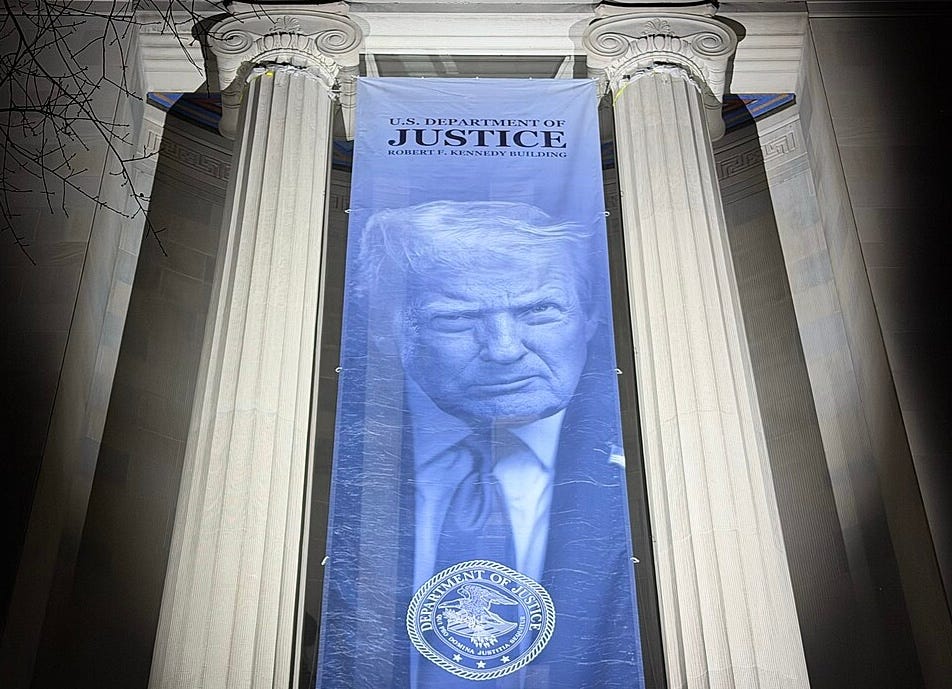
Within the span of a day, the Trump administration abandoned, and then reversed its decision to abandon, its defense of punitive executive orders that targeted certain law firms by threatening to cut off all government contracts in which the firms had provided services and restrict their access to federal agencies. The Department of Justice did not explain this abrupt change of course. Perhaps it will have more to say in the brief it is scheduled to file Friday.
But the question now is how to evaluate the various courses that have been open to the Trump administration—defending or not defending the orders—and whether it matters that it equivocated, filed a motion to withdraw the appeals, and has now apparently decided to resume the fight.
Why the Administration Might Have Considered Abandoning the Cases
The administration could not have launched these orders with any reasonable expectation of winning legal challenges. This outcome was predictable from the beginning. The orders were plainly unlawful retaliatory attacks on law firms that had incurred the president’s personal wrath for representing clients, and hiring lawyers, he disliked. The firms that “settled” rather than contest the orders were well aware that they were making peace with an illegal White House program. But regardless of the plainly foreseeable legal outcome, the president would still benefit from the EOs. He would have the satisfaction of striking out at his perceived adversaries and observing how the firms would respond to the threat to their business interests from the mere issuance of his orders.
Trump presumably got the satisfaction he was after. And more of the firms that were targeted chose to settle rather than sue: nine versus four. The settling firms collectively committed close to $1 billion in pro bono legal services to causes favored by the administration. A number of them agreed to an ongoing engagement with the administration in the implementation of the settlements, essentially inviting the government to have some continuing say over their internal governance and operations. Many firms who were not under attack notably declined to join the defense of the ones who were. News organizations reported a chilling effect on the “big firm” legal profession. The press also indicated that large firms adopted fresh caution in considering taking on cases that could draw Trump’s ire. All of this occurred even as the administration suffered decisive losses in court.
Moreover, the law firm community is now on notice that the administration is fully prepared to deploy clearly unlawful strategies that cannot be sustained in the courts but will, as the issues are litigated, achieve some part of the president’s purposes. Some targeted firms did lose clients and may have had reason to fear more losses if, absent a settlement, the conflict continued. Firm management in those cases cannot gauge with certainty the prospective clients who might have retained them but did not for fear of aligning with a declared enemy of the president of the United States. While the firms contesting the orders may have attracted new business from clients impressed with their professional independence and resolve, it is hard to know in these circumstances how the economic effects over time would ultimately shake out.
The administration knows that some firms will not take a chance. As Trump declared last March, “Well, the law firms all want to make deals . . . They’re not babies. They’re very sophisticated people.” In short, the Trump administration can close out the current cases, but it has made clear enough what it is capable of doing if so motivated.
Moreover, unlike Trump’s attacks on universities and the media, a sustained war on law firms has limited political salience. It is not coincidental that the administration has pressed on these other fronts, such as its continuing standoff with Harvard and the suits against offending news organizations, but months have passed without another law firm executive order. Law firms may not exemplify for Trump and his wider base the same systemic left-wing capture of powerful institutions. The singling out in the law firm EOs of specific lawyers Trump despises accentuated the orders’ very personal retaliatory dimension.
Finally, it is perhaps not coincidental that the appeals were dropped as the administration defends another case involving the denial of a security clearance to a lawyer who has represented whistleblowers in the intelligence and law enforcement communities. It may have concluded that it should clear the decks of the cases it cannot win so that it has a better chance of winning this one.
In sum, from the administration’s perspective, it is not obvious why it would bother with the appeals. It is certain to lose, and it is not advantageous to add appellate court validation to its losing record in the lower courts. And the administration was already able to get a lot out of a lawless program not just rejected but scorned by the courts.
Why the Administration Might Have Resumed the Defense of the Illegal Orders
A number of reasons could explain the administration’s about-face.
The president may have decided that he did not like the first run of stories saying that he had caved. The president had gloated over these settlements. Last March, he bragged, “They’re all bending and saying: ‘Sir, thank you very much.’ Nobody can believe it. Law firms are just saying: ‘Where do I sign? Where do I sign?’” A loss in court likely stings him less than admission of defeat. He does not care to concede losses. (CNN reported that “the decision came after the announcement about dropping the cases against the firms drew the ire of Trump and his top aide Stephen Miller,” citing an anonymous source. This seems to imply that Trump may have heard of the DOJ reversal after-the-fact and ordered that it be rescinded. But it is very hard to accept that DOJ did not inform the White House of its plan to end the appeals, and it is equally, if not more likely, that Trump knew and approved and thought better of it when he read the press coverage.)
The administration may also have had second thoughts about dropping the case out of a concern about its various impacts on the law firm community. One concern might be that this community would engage again, however gradually, in the activities his orders were intended to stop or deter. The end of the cases, establishing a clear record of illegality, would also create pressures on the firms to reconsider any obligation to honor those agreements, such as the commitment of millions to pro bono representation of conservative causes. And a firm that chose to honor them anyway—to volunteer their compliance with settlements reached pursuant to illegal executive orders—would face a fresh round of public criticisms of their conduct.
Perhaps, too, law firms that settled rather than contest the orders complained to the White House. They would look all the worse for having cut deals to escape orders the administration declines to defend.
Conclusion: How the Administration Looks Even Worse Than Before
The administration’s orders were legally indefensible. The administration seemed, if only briefly, to recognize that its cause was utterly lost, but then chose to double down on this defense of the indefensible. If it was possible to bring even more discredit to this attack on the legal profession, the administration managed to do it over a span of less than 24 hours.
And what is to be made of the executive branch lawyers who fashioned these patently illegal orders? The White House counsel was one of them, if not the ultimately responsible lawyer, and he has reportedly been in the middle of the “will we or won’t we?” debate within the administration in the last day. Yet here, as of the end of March 3, is where things have landed. How then do we assess his role in this administration?
