


Please click here to opt in to receive via email our Roundup—brief daily summaries of news developments and commentary related to executive power.
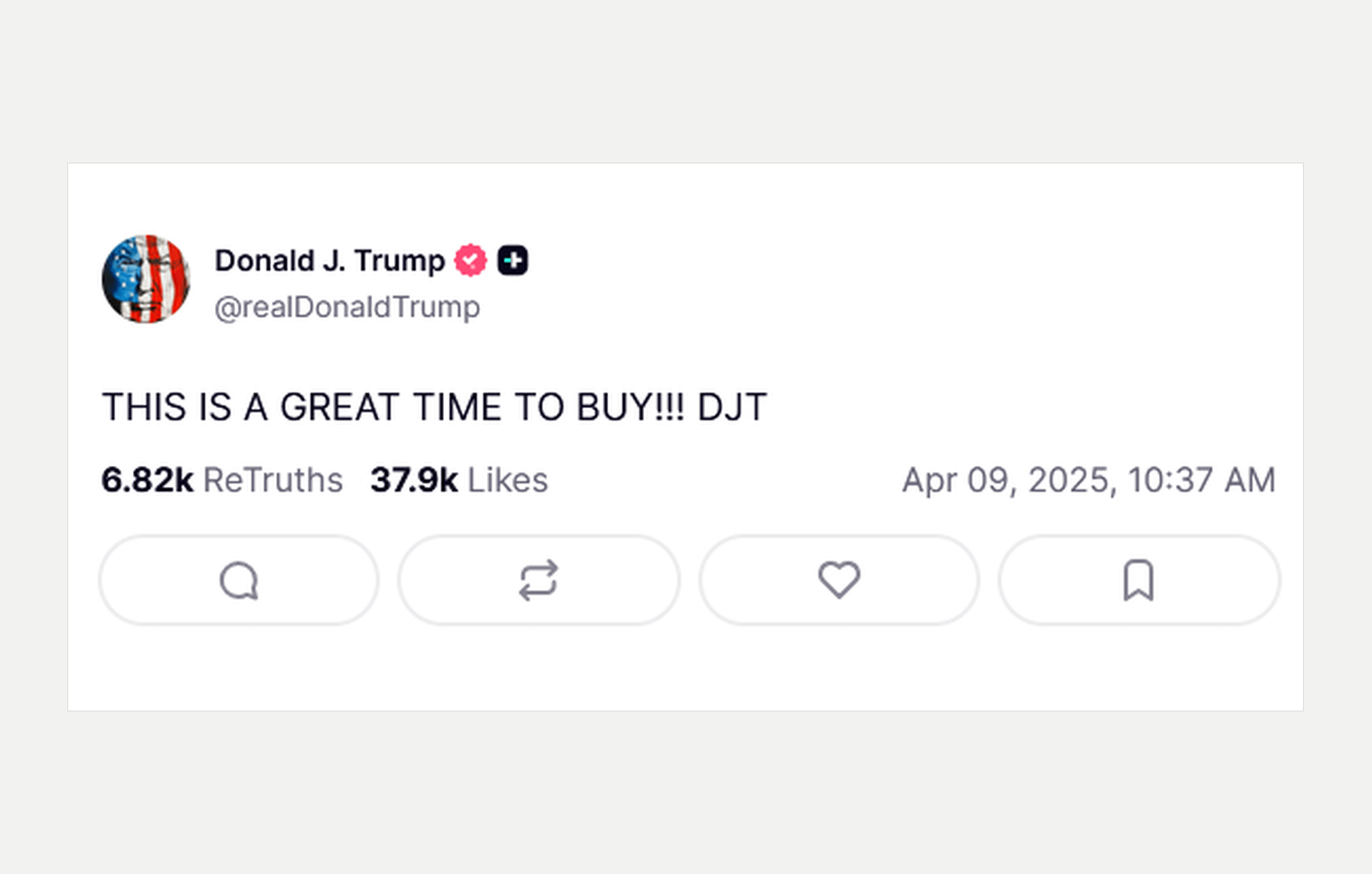
Since Aug. 1, President Trump has been profiting from his Truth Social announcements of official actions or positions. Trump Media and Technology Group, which owns Truth Social, has announced that, for a fee of up to $100,000 a month, Wall Street traders will have milliseconds faster access to “market-moving” presidential statements issued on the platform. For firms competing to trade successfully on this information, milliseconds can make a difference of many millions of dollars. If the sales pitch for this new subscription service is successful, it will be helpful to the reportedly ailing Truth Social, but therefore also to the president, whose 41.5% stake is held in a revocable trust of which he is the sole beneficiary and his son Donald Trump Jr. the sole trustee.
Commentators and members of Congress, including Republicans, have sharply questioned this arrangement. The question of its legality is contested, and I do not take it up here. The ethical failing could not be clearer: a flat-out, egregious conflict of interest. Any Truth Social announcement of a governmental or presidential action or policy, or simply the expression of an opinion, stands to be shaped by Trump’s private financial interest in building this new roster of paid subscription clients.
How is it, then, that Trump, mired in dismal job performance ratings, chooses once again to ignore the conflicts and make flagrant use of his office to make a lot of money? He is evidently discounting the political costs, and he is well defended against any legal or ethics regulatory ramifications. By a combination of his control of the Department of Justice, the uncertain contours of his constitutional immunities, and a potential self-pardon, he can minimize any risk that the conflicts lead to a public corruption prosecution. Within the executive branch, he has disabled the ethics regulatory machinery and need not fear criticism or embarrassment from that quarter. By his own account, Trump concluded after his first term that “nobody cared” about ethics rules. To some degree the polling data bear him out, as only “a small sliver” of the public rank his profiteering as a primary concern about his presidency. And even if voters are beginning to take notice of the scale of his self-enrichment, their attention to the issue may stem more from overall dissatisfaction with the way he is doing his job than from a focused rejection of abuse of office for personal financial gain.
The challenge for the balance of this term and then again after he leaves office is building the case that conflicts of interest in the presidency matter on their own terms—in the good times and the bad, irrespective of the president’s approval ratings on other measures. It will not be easy. Process issues—like campaign finance or ethics regulation—are rarely at the top of voters’ minds.
But Trump’s self-enrichment requires attention not only for its head-snapping brazenness, but as a defining feature of a particular model for presidential governance: what I have characterized previously as the “business model.” This is one in which “deals” forged out of a range of private interests and incentives, including the president’s own, are seen as necessarily serving the public interest as well. This model does not allow for the application of standard conflict-of-interest and other ethical rules, because it does not recognize the standard line drawn between public and private interests.
The Truth Social subscription service fits within this model. Trump is working out a deal within the interests and incentives of the stock market, which he cites as the leading indicator of his successful stewardship of the economy. The new social media subscription service is a good deal for smart traders, if also for Trump; they will make money, and he will make money. It is (the theory goes) good for the market and good for Truth Social. Those traders who decline to participate are missing out on a good deal. Conflict of interest has nothing to do with it.
The demise of conflict of interest relates to the administration’s aggressive approach to the use—and, in the standard of view, abuse—of power. Conflict-of-interest is one kind of abuse of power, defined by the potential or actual subordination of the public interest to private gain. Other abuses may also serve presidential dealmaking, and not always in circumstances that involve a direct financial benefit. When Trump launched his vendetta against major national law firms, he denied that the settlements he exacted from a number of them were coercive, an abuse of power. His executive orders targeting firms that had aroused his ire were the first—and, courts have so far uniformly held, illegal—steps in a series of negotiations. These firms that settled did so because they “want to make deals,” because “they’re very sophisticated people.” Ethics has no place in this understanding of how power may be used, because, as I wrote before on the business model, “ethics imposes limits on the cutting of deals,” and for that reason, in this view, “are just dysfunctional, and therefore bad policy.”
The suspicion and often outright rejection of expertise follow from this dismissal of standard ethical considerations. In theory, policy experts guide deliberations over the public welfare. They help to find that space outside the clash of private interests where something like a common good resides. The influence of experts largely disappears in the business model picture of that common good as the best possible deal cut among various and competing private interests. On this account, this president, touted as the consummate dealmaker, is the kind of expert, a dealmaking expert, who is most needed. Among the experts neutered in this administration are those who specialize in the standard model of conflict-of-interest and government ethics regulation.
How the administration views conflict of interest is something new, a world apart from long-standing conceptions of how government fulfills its responsibilities. Personal gain is well and very intentionally served by this “business model” presidency, but it is a model that, more fundamentally, has no room for ethical constraints on the uses of power to make deals on a thoroughly privatized understanding of the public interest.
