


Please click here to opt in to receive via email our Roundup—brief daily summaries of news developments and commentary related to executive power.
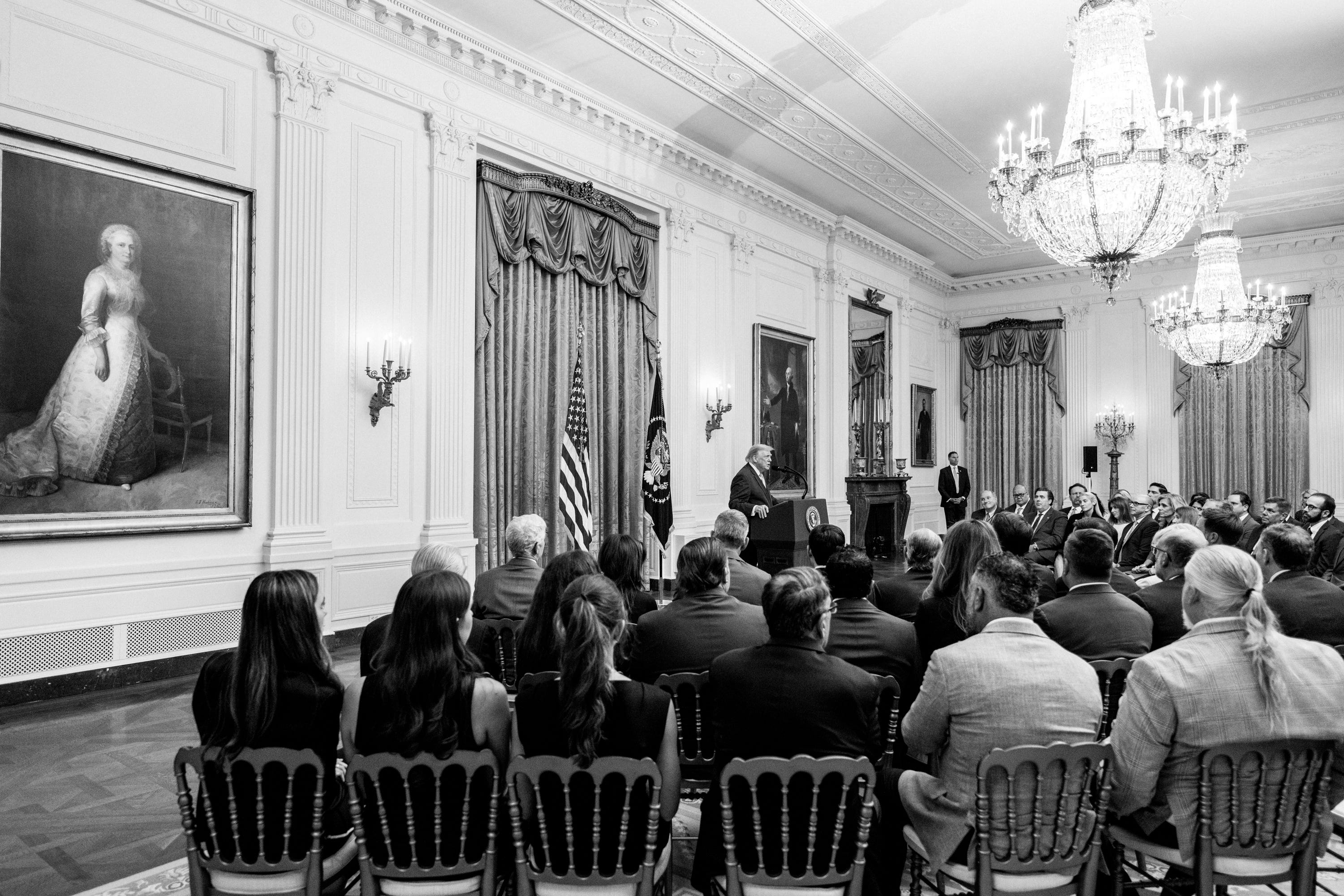
President Trump did not succeed as he had hoped with the “really big news” of his “election integrity” speech last week. The post-address commentary was almost universally negative. David Graham, one of the critics, sees the speech as a “sign of desperation” from a president whose “attempts to concretely interfere with the 2026 election thus far have almost all failed.” What remains for him, Graham wrote, is just “attempting to sow chaos and doubt among Americans.”
I do not disagree with Graham about the failures of Trump’s “election integrity” program to this point. Graham cited a number of the Trump administration legal initiatives that have not so far survived legal challenges. It is also unlikely that Trump will give up. His insistence that U.S. elections have been “rigged” reflects two deeply personal concerns: his refusal to concede that he lost the 2020 election, and his openly stated fear that Democratic success in the midterms could subject him to a rash of congressional investigations and even impeachment during the last two years of his presidency.
Trump now faces—and may continue to face—a still greater problem in pressing his message of voter fraud and achieving the objective of sowing doubt and chaos. Three networks declined to grant the White House’s request for a live national primetime broadcast, and two, CBS and MS Now, aired part of the address live, cutting away before Trump concluded his remarks. (Fox was the only major network to air the speech in its entirety.) This is an extraordinary development. Never before, to my knowledge, has a president declared an intention to address what he declared to be a major national security problem—a “crisis”—and failed to obtain the free broadcast time the White House requested. In the past, networks have sometimes, if rarely, denied a president’s airtime request for speeches judged to be too political, or devoid of news value. Yet media organizations have long given the president leeway when seeking to speak to national security issues in “circumstances of national emergencies, or urgent Presidential announcements.”
But they declined to do so on this occasion, and Trump was infuriated. He added to the speech a denunciation of the recalcitrant networks, charging them with being “part of a plot” and clearly threatening their licenses. A question now is whether the conflict will end there or Trump will follow up on this threat to licenses, or strike back in other ways to punish the media for this most recent offense, and by action or threat, cow them into more pliant behavior in the future.
The most dangerous route he could consider is the threatened exercise of emergency powers directed at media unwilling to cover as he wishes the alleged election integrity crisis. A provision of federal communications law authorizes the president to use or take control of a station, or close it, upon proclamation of a war, or “state of public peril . . . or other national emergency . . . if he deems it necessary in the interest of national security or defense.” In a 1941 opinion, the Department of Justice concluded that a president’s war powers over public communications were broad, anchored not only in this statute but in “his other constitutional powers” to protect national security. The statute contains no limiting definition of key terms such as “public peril.” Trump’s OLC could be expected to embrace a sweeping, if contestable, view of this presidential power, and as Trump has made clear by executive order, he has the last word within the executive branch on the law—such as whether this statute provides him, in one commentator’s words, “full control to . . . commandeer the country’s entire electronic regulatory system.”
As broad as the authority granted under this statute may seem, its exercise in these circumstances is far from immune from legal challenge. One statutory argument would focus on the reference to radio communications or electromagnetic radiation within certain levels that are “suitable for use as a navigational aid.” The legislative history suggests that Congress intended to enable presidents to address a specific threat: an enemy’s use of radiation to guide enemy aircraft and missile attacks on the homeland. This would be one line of defense against the president’s potential resort, or threat to resort, to this “emergency” authority in the election-related context.
Bolstering the attack on this claim of authority would be application of the “major questions doctrine,” which requires “clear congressional authorization” to justify exercises of “highly consequential power beyond what Congress could reasonably be understood to have granted.” To the extent that the doctrine applies, as the Court has suggested, to cases of major “economic and political significance,” a presidential invocation of emergency authority under this provision of the Communications Act of 1934 would seem clearly to be one such instance. In a court test, the president would also face the consequences of his loss of credibility in asserting the emergency or peril of a compromised voting system. In this respect, the speech last week dealt a further blow to his administration’s legal position in defending this or any other “emergency” power to protect against election subversion.
Of course, Trump could pursue the more tested strategy involving the weaponized Department of Justice. As the press probes the process by which intelligence was used and redactions made in the released documents, the administration could turn to DOJ to defend against further disclosures damaging to the president’s credibility. There are multiple ways DOJ can harass news organizations and their reporters. A fight is already underway over a very different national security question raised by the press regarding the president’s use of the Qatari-gifted Air Force One. As in that case, the initiation of investigations of alleged leaks in “election integrity” reporting are among the weapons that Trump’s DOJ could deploy against the media.
It is impossible to say what direction Trump’s response to the failed speech will take. The purpose here is to flag the ways a president like Trump might respond, but also to call attention again to the legal reforms, such as changes to federal communications law to clearly limit presidential abuse of emergency authority, which should be added to the list for consideration when the time comes to reconstruct the presidency.
