


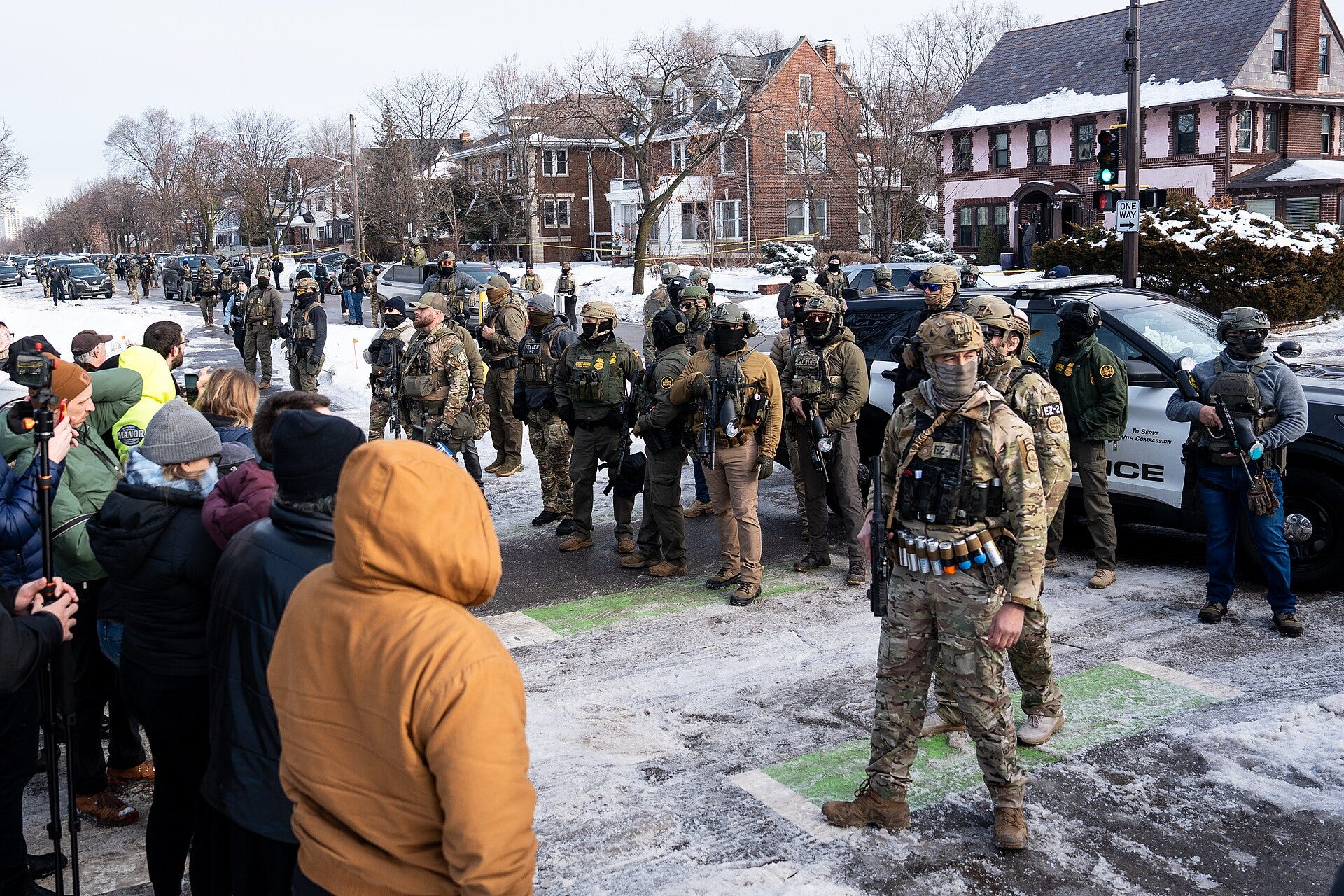
In light of President Trump’s threat this morning to “institute the INSURRECTION ACT,” we thought it might be useful to collect our main writings on the Act, its dangers, and reform possibilities, in one place.
We wrote in the New York Times recently about the dangers of the Insurrection Act, and a few years ago on how we thought it should be reformed. The latter piece was consonant with an American Law Institute project we led in the Spring of 2024 on “Principles for Insurrection Act Reform.” The project was supported by “a group with a membership that spans a range of legal and political views” and who members “have varied backgrounds in constitutional law, national security law, and military law, and in senior positions of the U.S. Government.”
As Background, the Principles explained:
There has been a need from the beginning of the nation for armed forces to be available in extreme cases to respond to serious domestic threats and harms to public safety and security. There has also long been a concern about the use of such forces in this context. U.S. military officials past and present have been wary of involvement by the federal armed forces in policing their own citizens. Others have cited dangers to citizens’ rights and state sovereignty.
The Posse Comitatus Act of 1878 provides an important limitation on the use of armed forces to execute the laws. That statute today provides: “Whoever, except in cases and under circumstances expressly authorized by the Constitution or Act of Congress, willfully uses any part of the Army, the Navy, the Marine Corps, the Air Force, or the Space Force as a posse comitatus or otherwise to execute the laws shall be fined under this title or imprisoned not more than two years, or both.” 18 U.S.C. § 1385.
The Insurrection Act constitutes an express statutory authorization within the terms of the Posse Comitatus Act. Presidents have several dozen times invoked the Insurrection Act to address major outbreaks of violence and the imminent or actual collapse of federal or state law enforcement. Yet the need for presidents to invoke the Insurrection Act today must be considered in light of the size and capacity of modern law-enforcement agencies at the state and local level, as well as a large federal law enforcement capacity available to the president, which in 2020 stood at almost 137,000 federal officials authorized to carry firearms, make arrests, or both.
The Insurrection Act in its current form provides broad authority without sufficient checks and balances. It is an old statute with vague triggers for the indefinite domestic use of military force. Some of these triggers are expressed in antiquated language. And the Insurrection Act contemplates no role for Congress in the use of the authorities under the Act even though the president receives those authorities from Congress. These flaws in the Insurrection Act have been clear for a long time and have prompted numerous proposals for reform.
Against this background, the group offered these principles for reform:
A. The “Triggers” for the President’s Invocation of Authority Under the Insurrection Act
Two basic principles should guide reform of the Insurrection Act’s triggers of authority.
Eliminate Antiquated Terms
Under the Insurrection Act, a president’s authority to deploy U.S. troops turns on terms—including unlawful “combinations,” “obstructions,” and “assemblages”—that lack settled contemporary 3 meaning. The important purposes of the statute would be better served, the scope of presidential authority would be clearer, and appropriate congressional oversight would be materially enhanced, if reform of the law removed such terms.
Strengthen the Conditions for the Act’s Use
Where the president’s deployment of U.S. troops is authorized as a response to the collapse of state or federal law enforcement, a reformed Insurrection Act should more clearly specify (i) the goal of ensuring enforcement and (ii) the requirement that the deployment be necessary to protect public safety and security. For example, the current authority to suppress “domestic violence” in 10 U.S.C. § 253 should be amended to make clear that the violence must be such that it overwhelms the capacity of federal, state, and local authorities to protect public safety and security.
These strengthened conditions on the use of the Insurrection Act are consistent with, but also clarify, the basis for well-recognized past invocations of the Act, such as those by Presidents Eisenhower and Kennedy to achieve compliance with federal-court desegregation orders.
B. Time Limits, Reporting, and Consultation
Several statutes require the president and other executive branch officials to consult with and report to Congress on uses of force, covert operations, and other military or intelligence activities abroad. See, e.g., 10 U.S.C. § 130f (sensitive military operations); 50 U.S.C. § 3093(b), (c) (covert actions); 50 U.S.C. § 3092(a) (intelligence activities other than covert action); 50 U.S.C. §§ 1542-43 (hostilities or imminent hostilities by the armed forces). Congress has also imposed a time constraint on certain presidential uses of the armed forces outside the United States, subject to subsequent congressional approval. 50 U.S.C. §§ 1544-45.
Although the Insurrection Act is grounded in Congress’s power over the militia and war, the Act lacks any analogous reporting or consultation requirements. It also lacks time limits on the deployment of the armed forces or militia. From the perspective of democratic governance and constitutional principle, the use of armed forces and the militia in the domestic sphere can be as significant as the use of armed forces abroad. Congress in the exercise of its constitutional prerogatives should establish analogous reporting and consultation requirements, and time-limit constraints, on presidential deployments under the Insurrection Act.
A reformed Insurrection Act should:
Require the president to consult, prior to the deployment of troops, with the governor of any state into which troops will be deployed.
Require the president to make findings on the need to invoke the Insurrection Act, and to report these findings to Congress, along with a summary of consultations with state authorities, within 24 hours of deployment.
Establish a time limit on the president’s authority to deploy troops under the Insurrection Act. The time limit should not exceed 30 days absent renewed congressional authorization.
Establish a fast-track procedure for Congress to vote on renewal of presidential authority under the Insurrection Act.
C. Judicial Review
Insurrection Act reform should not include a provision for judicial review. Judicial review would likely be available to address discrete issues under extant law, and the Supreme Court has made clear the president’s invocation of the Act will receive significant deference. The constitutionally guaranteed writ of habeas corpus remains available at all times.
