


Please click here to opt in to receive via email our Roundup—brief daily summaries of news developments and commentary related to executive power.
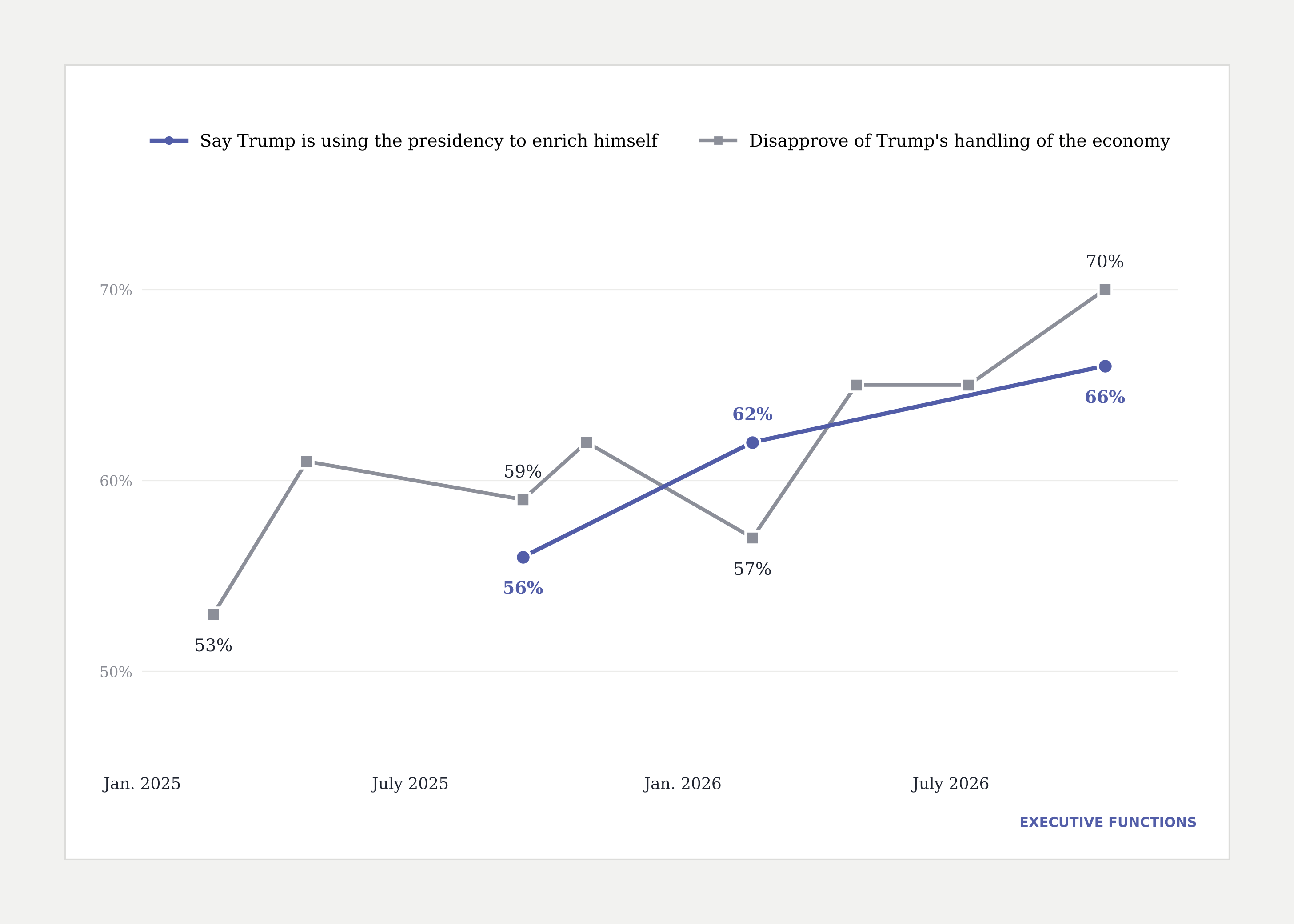
Numerous polls indicate a sharp and surging public disapproval of Donald Trump’s business activities and self-enrichment in office. In a Fox News poll published Oct. 14, government corruption has moved ahead of inflation and the cost of living as voters’ primary concern. There is evidence that this concern is focused on Trump’s acquisition of vast wealth in this second term and is found among Republicans as well as Democrats and independents. An Oct. 18 Washington Post poll finds that “nearly 2 in 3 Americans say President Donald Trump is using the presidency to enrich himself,” and that “most of the increase over the past year has come from people who lean Republican.” Yet another poll earlier this year found that two in three independents have concluded that Trump’s business interests influence his decisions as president.
This raises the question of how Trump, who has boasted about his money-making capabilities, came to alienate so wide a swath of voters who might once have been impressed. One possible explanation is that, nearly two years into this administration, he just went too far. As Trump’s money-making has passed into the billions of dollars, a public willing to admire it or look the other way has come to be acutely alarmed. Particular stories may have broken through, such as the news that a Russian oligarch close to Vladimir Putin paid substantial sums to underwrite the celebrations for Donald Trump Jr.’s recent wedding.
It is just as probable that corruption has soared as a concern in proportion to mounting public disaffection with Trump’s governance. Voters might have accepted Trump’s aggressive pursuit of vast wealth in return for his construction of “the greatest economy in the history of the world” for their benefit. He would be making money for himself, yes, but also for them. The skills he displayed in his pursuit of self-enrichment would yield benefits for the public at large. There is substantial evidence in the polls for this connection—alarm over corruption triggered by unhappiness with job performance.
The good news is that the public does care about corruption. The bad news is that the widespread rejection of flagrant self-enrichment we see today materialized primarily as a critical response to governance failure.
Political science literature has consistently shown that the public generally believes that politicians are corrupt, “in it for themselves,” and that it neither expects much from nor trusts much in reforms passed by those same politicians, purportedly to address the problem. Reformers will often reply that the public registers strong disapproval of corruption—of the role of money in politics, for example—and, in the abstract, they will express support for reforms to limit political spending or expand transparency requirements. Yet voters don’t expect much to come of any specific measures that are taken. And voters also seem to be, as in the Trump case, somewhat “transactional”—they’ll put up with a certain amount of corruption as long as the government delivers.
What does this “on-off” cycle mean for corruption as a public policy issue and the prospects for future reform? Of course, a congressional majority could pursue the reform project regardless of whether voters will have much faith in the outcome. The public will not oppose reform. They may support it in principle. They just do not take it all that seriously.
But it would certainly help if reform could be organized around strong, publicly accessible arguments that it will make a difference to voters on the issues they care about. An example I have written about recently is the deep public suspicion of tech companies and their explosive development of the AI industry, and the wide support for an end to the construction of data centers. I suggested that there is a path to reform through the strengthening of an already existing but loophole-ridden limitation on political spending by federal contractors—which the large tech companies are. Elon Musk’s SpaceX alone has over $25 billion in contracts, while Musk, busily mining one of the loopholes, has spent so far over $400 million on federal campaigns this election cycle. Billions are involved in the relationship between the government and the tech industry: the billions in money the government doles out to the companies, and the hundreds of millions in spending by these companies and their executives to protect and expand this relationship.
Structural reform within that context may bring home to voters—more than any “too much money in politics” line of argument—why it is that our laws should constrain this category of political spending. For voters to care about a reform program, and for politicians to respond to those concerns, a case needs to be made for the relationship of reform to concrete governance issues voters care about.
