


Please click here to opt in to receive via email our Roundup—brief daily summaries of news developments and commentary related to executive power.
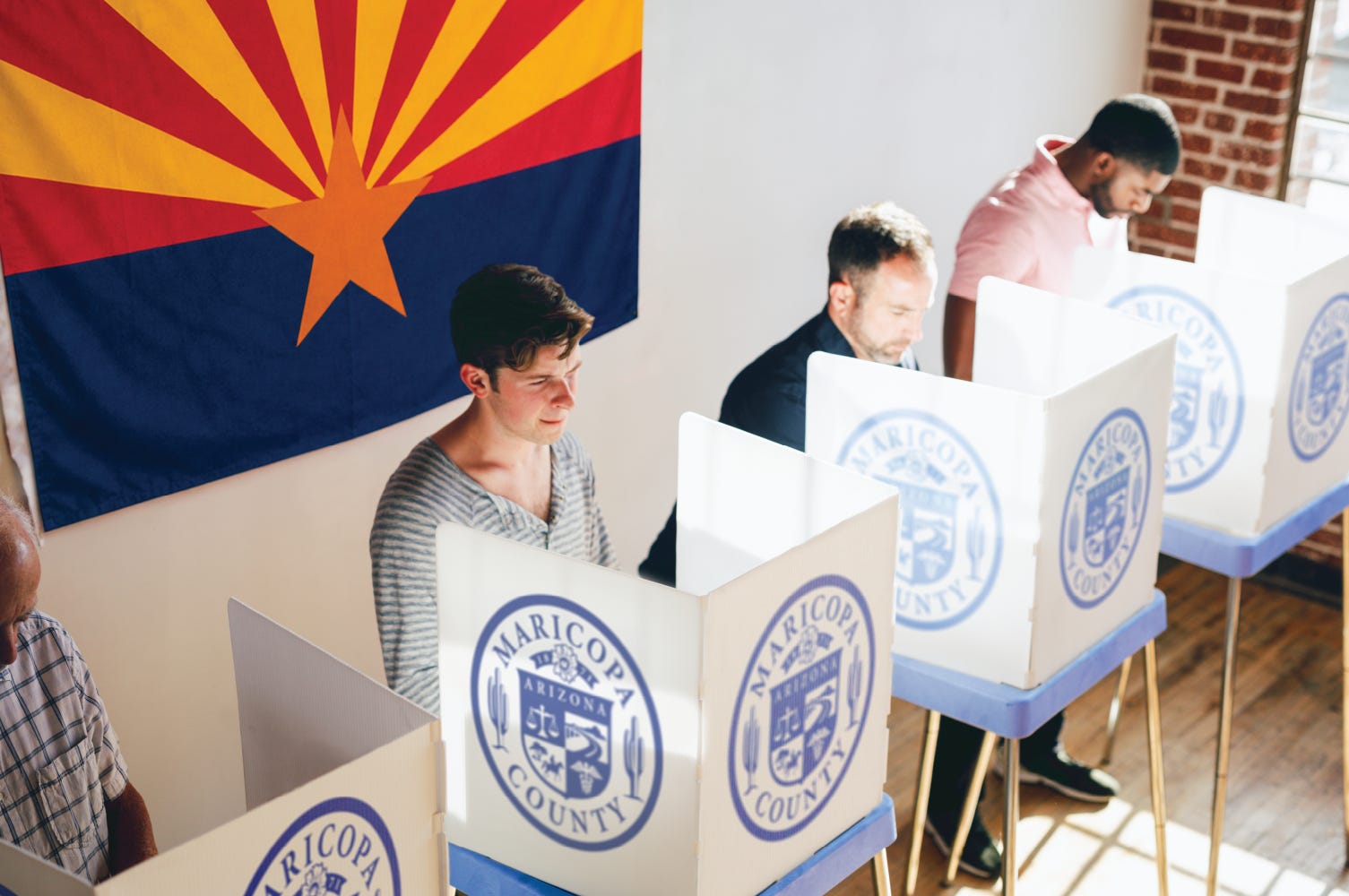
Around the country on election night, losing Republican candidates conceded. Donald Trump said he would respect his party’s massive midterm defeat. The vote count proceeded smoothly: administrative issues cropped up here and there, as they do in each election cycle, and election officials kept the public informed of the nature of each problem and the path to its resolution. The streets were quiet; the process was peaceful.
And all of this occurred against a background of Trump’s ceaseless attacks on the integrity of voting systems and an extraordinary assertion of presidential authority, by executive order and through litigation, to intervene in the conduct of elections. What accounts for the normalcy of this Election Day, and the mail and early voting that preceded it? In this piece, I point to a few key factors that contributed to a different outcome—a free and fair election conducted under law—than many had feared.
The Flawed Premises and Execution of the Trump Strategy
Trump had to navigate a major obstacle to his program of asserting presidential authority over the rules and conduct of election administration: the Constitution confers this power on the states—or on Congress, if it chooses to prescribe the rules for federal elections.
The administration’s lawyers tried first a direct challenge to the constitutional allocation, issuing executive orders that, among other measures, directed the Election Assistance Commission to change the rules governing eligibility to use the Federal Form for voter registration. This gambit failed in the courts, as did President Trump’s effort to position the United States Postal Service as the arbiter of mailable election material.
The administration came to lean aggressively on a strategy built around purported executive law enforcement functions. It focused its messaging and efforts on preventing the deluge of illegal noncitizen voting the president has alleged ever since his charge in 2016 that it accounted for Hillary Clinton’s nearly 3 million popular-vote plurality. On this theory, the Department of Justice sought to coerce the state of California to adopt the federal government’s administrative procedures for addressing voter eligibility. It also threatened election officials in that state and elsewhere with criminal prosecution if they did not submit to the executive branch’s directives. The courts—and, decisively, the Supreme Court—have rejected this path to the exercise of presidential power over the conduct of elections.
As of mid-October, by one count: “At least 34 federal district court decisions have either temporarily halted or permanently blocked efforts by the administration to interfere in elections, including 22 judges appointed by Democratic presidents and 12 judges appointed by Republican presidents (including 8 appointed by President Trump himself).”
It did not help the president or the department that, time and again, they made false claims in support of the president’s “election integrity” program. The president delivered a nationwide address to sound the alarm on a voting system he characterized as disgracefully unreliable and infected through and through with fraud. What he offered to make this case were recycled allegations that had been long ago discredited. The Department of Justice made similarly groundless claims about the numbers of noncitizens on the registration rolls in particular states. The collapse of these claims was spectacular: in Nevada, the administration alleged that there were thousands of noncitizens on the rolls, a number that, after state review, wound up being whittled down to zero. In an extraordinary move, the United States solicitor general’s application to the Supreme Court for emergency relief in the California case carefully declined to embrace DOJ’s factual assertions about the list of noncitizens in that state “believed” to be on the voter rolls. DOJ eventually had to concede that the list was marred by a “high” error rate.
One threat that loomed over the course of the cycle was the potential that Trump would resort to “emergency” authority—deploying ICE agents to polling locations, seizing ballots and machinery as the administration did in the investigation it instituted in 2025 into the 2020 presidential election in Fulton County, Georgia, or calling out the troops under the Insurrection Act. Historians or reporters with access in the future to papers and reliable witness accounts may one day be able to piece together why none of this happened.
One could speculate. Perhaps the experience with ICE sweeps, most notably in Minnesota, underscored public intolerance for the extent of the upheaval he would be responsible for. White Houses (via their political party) poll extensively: the data may have confirmed that the risks would exceed the rewards. Perhaps lawyers warned that he would, once again, fail in the courts and that there was little gain to go with the risk.
As I discuss more below, it also appears that, outside hard-core election denialist circles, there was political resistance within his own party, especially at the state and local levels, to how far he might go in imposing his will on the electoral process.
The Supreme Court
The Department of Justice’s failed suit against the state of California was a last-ditch maneuver blending the messaging and policy priorities of prime importance to this presidency: fraud in the elections, the specter of massive noncitizen voting, and extraordinary claims of executive power. The Supreme Court swiftly sent the government packing, denying within the day the emergency relief the administration sought. It did so without inviting briefing by other parties and with no noted dissents. It was a major blow to the administration on the eve of the vote.
Overall, the Court’s record in addressing the president’s election denialist program was not what its most ardent critics most feared—a Court that, as Ken Burns suggested on Election Day in the New York Times, was “compromised,” by which he apparently meant an institution in league with Trump, the far right, or both. On election administration issues, a Court majority was manifestly unfriendly to the president’s election interference program. The Court blocked the president’s unprecedented attempt to have the United States Postal Service deny the use of the mails for official election materials and to construe federal law to prevent states from adopting the “postmark” rules for the timely receipt of a mail ballot. It also stopped the state of Missouri from disregarding its own state Supreme Court and using an unlawful redistricting map to knock off one more Democratic House incumbent. And in the California noncitizen voting case, the Court delivered as clear a rejection as possible of what was, in the closing days of the election, a signature nationwide administration effort to intervene in and disrupt state electoral processes. When the Court did clear the way for the administration to share with states the federal SAVE database for use in screening voter rolls for noncitizens, election law expert Rick Hasen, among others, noted that “both the majority and dissent agree that this case is likely to have limited impact on the midterms….”
The Court’s sharpest critics will cite in response the Court’s decisions on gerrymandering, the Voting Rights Act, and campaign finance. This is where oversimplification in the critique of the Court takes hold. As I have written before, outside the field of election administration, a conservative Court majority is undoubtedly committed to a jurisprudence that provokes fierce progressive objections. This jurisprudence has been in active development for years, well before Trump came on the scene. Justice Kagan can certainly conclude that this approach is mistaken, exhibiting “a kind of lack of the appropriate concern or understanding of the consequences of their decisions.” But the Court’s record on election administration in this cycle does not support the claim that it was prepared to do “everything in its power to save Trump in the midterms.”
As of Election Day, the Trump lawyers would have had every reason to doubt that, if the voters turned against their boss, the Court would somehow save him—just as it declined in 2020 to come to his rescue.
The “System”
The United States conducts its elections in over 10,000 individual voting jurisdictions around the country. Election officials are committed to this highly decentralized system under state and local control, and voters by and large trust it. The voting controversies stoked by Trump in recent years have certainly exacted a toll on the level of public confidence, with a notable decrease in trust in mail voting. Democrats and Republicans have also long disagreed over whether the dominant concern in election administration policy should be voter fraud or voter access. But the running of elections has remained predominantly a state and local affair. In my travels around the country in the last two election cycles, meeting with community leaders and election officials, I have found little support among Republicans for a large role for the federal government.
At this state and local level, election officials from both parties resent the aspersions Trump has cast on the process—on the integrity of their work. They did not respond well to the public distrust he has baselessly and recklessly encouraged, or to DOJ’s threats to prosecute them for declining to follow federal government dictates at variance with state laws.
In preparing for and conducting the election, these officials, in red and blue states, have done the work they normally do. November 3, 2026, was an extraordinary political event, and this was possible because, for the approximately 124 million voters who cast their ballots, this election ran like any other.
