


Please click here to opt in to receive via email our Roundup—brief daily summaries of news developments and commentary related to executive power.
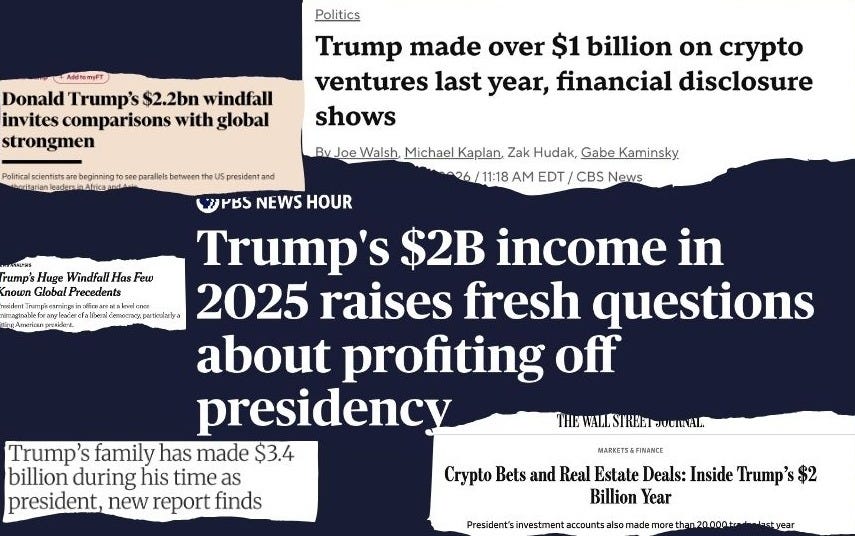
Commentaries about Donald Trump and his family’s unprecedented self-enrichment in office often sorrowfully conclude that it is likely legal. Support for this view ranges from the claim that the president faces “the weakest legal rules in history” and can easily exploit “loopholes” in the law, to the Supreme Court’s immunity decision and its rulings narrowing the reach of the federal bribery statute. And it has followed from this line of analysis that Congress can investigate and expose, with not much more to be done—unless the American public decides to inflict political punishment on the president and his party.
A number of the key claims are overdrawn and, in certain characterizations of the law, mistaken. The Supreme Court has not so limited application of the federal bribery law that it has reached the point of “functional futility.” It is also incorrect that the president somehow enjoys blanket protection for his business activities under Trump v. United States. On what is known—and much is not—Trump, his family, and other business partners are clearly running legal risks in the course of accruing this vast wealth. If they are operating on any expectation of impunity, Trump and his partners are probably relying on the pardon power—including a self-pardon.
What I believe to be the better understanding of the president’s legal exposure and likely defense is consequential, and not because it intimates or forecasts that he has certainly broken the law and will be eventually held accountable for it. It matters to the rule of law and the institution of the presidency that Trump’s aggressive pursuit of wealth while in office does, in fact, raise serious legal issues, and that the emergence of additional information about his business strategies may in the future, under a different Department of Justice, subject him to criminal law enforcement.
And the pardon power he might count on deploying in his defense will be more controversial than many assume—legally, not only politically. Congress has a role to play on this issue: It is in a position to challenge the self-protective use of the pardon power and is not by any means certain to fail.
The Supreme Court and Bribery. The president may be exempt from much of the conflict-of-interest regulation that applies to other executive branch officials, but he is subject to the criminal bribery law prohibition on demanding or accepting “anything of value . . . for being influenced in the performance of any official act.” In the immunity decision, Chief Justice Roberts, writing for the majority, sparred with Justice Barrett, who, in a concurrence, disagreed over the type of evidence of an official act that would be admissible in a bribery prosecution. They did agree, however, that a president was subject to the statute. While Roberts stated that a prosecutor cannot “admit testimony or private records of the President or his advisers probing the official act itself,” he or she “may point to the public record” to identify the official act associated with the bribe. The Department of Justice took the same position years ago that the prosecution of a president for bribery “raises no separation of powers question, let alone a serious one.”
Commentators fear, however, that the Supreme Court has so eviscerated the application of the law in other cases that public officials, including the president, can all too easily get around it. This complaint largely focuses on the Court’s ruling in McDonnell v. United States, which defines the kind of corrupt “official acts” that can be the basis for bribery liability. Without delving into great detail here, it is enough to note that the McDonnell case involved facts far removed from what has emerged in public disclosures and reporting about the president’s business dealings and their connection to the powers of his office. The $175,000 worth of corruption involved in McDonnell may have been “distasteful,” but it was distinctly small beer. As it stated repeatedly, the Court was largely concerned with preventing a situation in which “nearly anything” a public official did for a constituent or supporter could generate bribery liability. McDonnell was a unanimous decision, with the Court noting that its critical focus on government overreach was supported by amicus briefs filed by “White House counsel who worked in every administration from that of President Reagan to President Obama,” as well as two bipartisan groups of former state attorneys general. The Court averred its intent to leave “ample room for prosecuting corruption,” and it did.
Whether the president is liable for any such corruption rests on facts in a case involving billions of dollars at the intersection of his lucrative business interests around the globe and his exercise of the powers of his office. There are still many facts to be uncovered. The Trump business affairs are, in one sense, exposed to a significant degree of publicity through the operation of public reporting requirements, supplemented by investigative journalism. Yet they are also complex, involving domestic and far-flung international dealmaking through various entities. Key details relevant to a public corruption prosecution are simply not known and accessible only through formal inquiry. It is impossible at this point to assess the president’s and his business partners’ legal exposure for bribery. Whatever this case turns out to be, it is not the McDonnell case.
The Supreme Court and Presidential Immunity. It is also hard to imagine any lawyer advising the president that the immunity decision insulates him from bribery liability. The Court did not extend protection for “unofficial acts.” Yet it has been suggested that, as a practical matter, the opinion may let presidents off the hook, because “[b]ribery, at its core, would involve taking illicit money in exchange for carrying out a so-called official act.” The theory here seems to be that so long as a president takes official action to execute or facilitate a bribery scheme, he has triggered immunity protection. This is not right. The statute is aimed explicitly at the abuse of power through an “official act.” The interpretation troubling the decision’s critics is also hard to square with the Court’s specific discussion of presidential liability for bribery and the evidence of an official act that would be admissible.
Even more fundamentally, the meaning of the immunity decision as it may apply to specific facts is a wide-open question. The Court left the “analysis ultimately . . . to the lower courts to perform in the first instance.” The line between official and unofficial acts, marking the difference between immunized and un-immunized conduct, may be unclear in some cases, but the facts will be determinative. Recall that Jack Smith filed a new indictment after Trump v. United States that trimmed the evidentiary allegations but retained the four counts contained in the original indictment.
The Supreme Court, the Congress, and the Pardon Power. The president might more reasonably hope to exercise the pardon power to protect all parties to an alleged bribery scheme. The private/official distinction so central to an immunity analysis would be irrelevant to an act of clemency. Moving to immunize family and business partners, he might add for good measure the personal protection of a self-pardon.
While reliance on the pardon power rests on firmer ground than the invocation of immunity, there are unanswered questions here as well. The constitutionality of a self-pardon is unsettled. Jack and I have proposed the Congress stake out ground on the question by enacting a statute prohibiting self-pardons. We wrote that “in the face of this uncertainty, Congress’s constitutional judgment can matter a lot.”
Our proposed statute would set forth, in a detailed preamble, the basis for Congress’s constitutional position, which I note here only in summary form. The pardon power may appear absolute as a textual matter, but there are powerful arguments to the contrary that draw, among other sources, on the president’s obligation to “faithfully” execute the law and the proviso in the Impeachment Clause that a president who is impeached and convicted “shall nevertheless be liable and subject to Indictment, Trial, Judgment and Punishment, according to Law.” Underpinning the case against self-pardon is what Saikrishna Prakash has termed the “ancient and powerful maxim of law” holding that “no person should be a judge in his or her own cause.” It is this maxim—what the Office of Legal Counsel referred to as a “fundamental rule”—that drove its barebones 1974 opinion that a self-pardon is impermissible.
And the case Congress can make has been strengthened considerably by the much-maligned immunity decision. The Court there stated that “the President is not above the law,” that “not everything the President does is official”: He cannot claim constitutional immunity from the legal consequences of whatever he chooses to do. As it turns out, a self-pardon is the ultimate test of this proposition. The Court’s decision rules out immunity for unofficial acts, or for official acts at the “outer perimeter” of his official responsibilities, if immunity is not necessary to “ensure that the President can undertake his constitutionally designated functions effectively.” If the president has the absolute power to pardon himself or herself, that is game, set, and match in his favor: absolute immunity, full stop. In a case testing a self-pardon, the Court will have to decide whether the president is indeed above the law, empowered by the Constitution to supply himself with the immunity that Trump v. United States does not. Add then to the preamble, taken full text from the opinion: “The President is not above the law.”
In our book, Jack and I suggested that Congress could effectuate its constitutional position by providing that federal courts may not accept a self-pardon, which cannot operate to deprive them of jurisdiction over any criminal or civil matter or operate to confer on the president any legal immunity from investigation or prosecution.
This could be revised in various ways, of course, and one possibility would be to address more expansively the nature of a prohibited self-pardon. Congress could make clear that impermissible pardons include those issued to others in cases with clear implications for the president’s personal liability under the criminal law. Consider the bribery statute: It applies to a president’s corrupt use of power to direct payments or benefits to “any other person or entity,” not only to himself. The use of a pardon to protect such others—a president’s partners in crime—also offends the “ancient and powerful maxim” against judging one’s own cause. Therefore, to address the various directions that an impermissibly self-protective pardon might take, the law could be drafted along these lines:
The President’s grant of a pardon shall not be accepted by any federal court of the United States, nor deprive any such court of jurisdiction over any criminal or civil matter, nor operate to confer on the President any legal immunity from investigation or prosecution, where such pardon is granted—
(A) To himself or herself, or
(B) To any other person or entity in any investigation in which the President is a subject or target or in any prosecution in which the President is an unindicted co-conspirator.
The Court will have to resolve the constitutionality of this kind of enactment, and it may turn out, as many worry, that a president is, in fact, above the law. It is just as possible that the Court will arrive at the opposite conclusion. Presidents seeking to save themselves from the consequences of corrupt conduct will have to fall back on the immunity decision and see how far it can be stretched, and even that is very far from a sure bet.
