


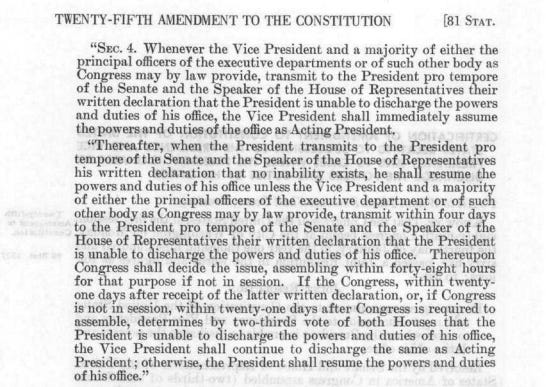
The 25th Amendment, providing for presidents to surrender or be relieved of their powers if unable to serve, allocates various roles in this process to the president, the vice president, the Cabinet and Congress. The most power resides within the executive branch, most notably with the vice president, who can block any attempted removal of the president from office because of inability, or clear the way for Congress to decide the issue. The 25th Amendment also gives the president, with or without the support of the vice president, ample authority to fight any move to oust him for inability to serve. Congress’s role is limited: It might have a vote in the matter, if the vice president and a majority of the Cabinet choose to permit it, and it can create by legislation a special “body” to perform the role that the Cabinet would otherwise play.
The advantage that the executive possesses in any conflict over presidential disability raises serious questions of the amendment’s efficacy. As Ross Douthat wrote in reflecting on the 25th Amendment years ago, “The presidency is not just another office. It has become, for good reasons and bad ones, a seat of semi-monarchical political power, a fixed place on which unimaginable pressures are daily brought to bear, and the final stopping point for decisions that can lead very swiftly to life or death for people the world over.” And the long and depressing history of executive lies and fecklessness in addressing questions of inability-to-serve only underscores the risks of depending on responsible behaviors by presidents, their vice presidents and their Cabinets.
Congress could do more, but it hasn’t, with the result that the executive has even more room for eluding transparency and accountability for issues of physical and mental fitness than the amendment already provides. The actions available to Congress would not solve the core problems with the amendment but could impose a greater measure of accountability on the executive, in particular the vice president, and it could, at long last, establish a standing special body to act in place of the Cabinet in any assessment of inability.
When the President Contests Inability-to-Serve Under the 25th Amendment
The 25th Amendment continues to work well in establishing the processes for presidential and vice-presidential succession in certain circumstances, such as when the president does not contest his inability, he or she is relieved of the powers of the office, and the office of the vice president has to be filled when the prior incumbent becomes acting president. But when the president challenges the loss of his power, the process functions more problematically.
First, the president’s hand-picked vice president is a bad choice to possess the power the amendment confers on this office in any controversy over executive fitness to serve. The president’s own Cabinet could be fully united in the judgment that the president is no longer fit to serve, and the vice president can successfully stand against the department heads and keep the president in power. Or the vice president can conclude that his political interests are best served by throwing his lot in with the Cabinet and removing the president. Or he cuts a deal with the president to ensure that he will have his support when running to succeed him.
Second, if the vice president does join with the Cabinet in a declaration of inability, the president can contest it, and Congress must act under tight time pressures, and by a two-thirds vote in both houses, to override the president’s resistance and clear the way for the vice president to become the acting president.
Third, Congress can insert itself earlier into the process by which inability is assessed (other than by voting to resolve a conflict within the executive branch), by establishing a special body to act in place of the Cabinet. But Congress has to do this “by law,” that is, pass a statute—which is subject to presidential veto.
Fourth, the leading authority on the 25th amendment, John Feerick, makes the important, but perhaps little-appreciated, point that even if Congress votes to affirm the vice president’s and Cabinet’s judgment of inability, “there is nothing to prevent [the president], after an adverse congressional decision, from issuing another recovery declaration, thereby activating the process again.” The president’s battle to retain his powers could go on indefinitely. It is an open question whether the courts could be called upon to adjudicate this issue or would pass on it as a “political question.”
As a practical and political matter, the president has the overwhelming advantage in any contest because the amendment does not define “unable” or “inability” or establish any process for achieving definition. Feerick has written (citing his book-length account of that history): “The terms ‘unable’ and ‘inability’ are undefined in either Section 3 or 4 of the Amendment, not as the result of an oversight, but rather ‘a judgment that a rigid constitutional definition was undesirable, since cases of inability could take various forms not neatly fitting into such a definition.’” The key congressional sponsor and others contended that in the end, the question was “political” in nature, to be resolved by political actors through the political process.
Accordingly, a president has wide latitude to argue that he is still fit for the office—that whatever physical or cognitive problems may have surfaced, they are not such that the extraordinary step of removal from office is warranted. No doubt the president can mobilize support for his position from some quarters. For example, not all presidential physicians have shone in their jobs when the time has come to speak medical truth to power. (And some White House physicians have had major problems of their own.)
(Partial) Fixes
Congress can act in two respects to enhance the operation of the 25th Amendment and restore some measure of balance in powers between the executive and the legislature in the implementation of the constitutional protections against an unfit executive.
Congress and the Vice President
Without further constitutional amendment, the VP has decisive power in this process, but it does not preclude accountability for its exercise. Under the amendment, the VP may answer in political terms to the president but in constitutional terms, he is independently obligated to answer for how he approaches this responsibility. Congress can request and, if necessary, subpoena, the vice president as an incident to its own authorities under the amendment, such as in relation to legislation to establish a “special body” or the management of such a body if already established. The president could not plausibly assert executive privilege to block Congress from receiving this testimony any more than he could assert the privilege to prevent the vice president from acting on a judgment of inability. Nor is it clear what privilege the vice president could assert, in either his capacity as a “legislative” or as an executive official.
Least controversially, the vice president could be asked what steps he has taken to prepare for these responsibilities in the event that he must meet them. Is there a protocol in place for deliberations under the amendment? In what way, if at all, does it provide for independent medical expertise? Congress could also in general terms explore with the vice president how he understands the scope of “inability.” More controversially, Congress could press the vice president on his view of specific, publicly reported health issues or behaviors.
Of course, a vice president could still decline to extend cooperation to these inquiries. The courts may have to resolve the question of his obligation to do so. Given the problems with the structure of the amendment and the history of irresponsible presidential behaviors around issues of inability, the case for Congress to take on this fight remains strong.
The Special Body
Under the amendment, Congress can act to establish a special body and substitute for the Cabinet an entity whose membership is less bound to the president by political or personal loyalties. It can structure the body as it wishes, providing for members with a range of medical expertise, or include appointments from the wider civil society and/or even from its own ranks. How the special body functions in its advisory capacity is also a matter for legislative determination in the design of the statute.
Congress does, however, have to pass a law to set up the body, and it must have the votes necessary to override a presidential veto if it is to be sure of success. The task for Congress would be to design a law that passes muster as responsible, bipartisan legislative handiwork crafted without obvious regard to any pending inability controversy. It managed to do so with the Electoral Count Reform Act in 2022, where its own authorities and procedures in the final stage of the presidential vote count were also at stake. And, again, while a president’s allies might characterize the passage of such legislation as a version of yet another impeachment, the establishment of such a body does not operate to oust the president from office. The vice president retains effective veto power to defend the president against what they deem a specious, politically motivated attack. Even if the president loses the support of the vice president and a majority of his Cabinet, Congress must affirm their judgment by a supermajority in both houses.
And the president who is seeking to deny suggestions of an inability to serve weakens his case, if such a case is gaining traction, by vetoing a law that Congress passes to insert medical expertise into the process. The president would at least carry the political burden of explaining why he opposes such a measure and seeks to keep the deliberations within the executive branch and the circle of senior government officials closest to him.
There is an important additional reason why Congress should be developing special body legislation on a bipartisan basis. In the event that Congress prepares to vote to resolve an actual conflict over inability and concludes that a special body with medical expertise should be established to act in place of the Cabinet, it will face potentially fatal time pressures. The amendment provides that a two-thirds vote to relieve the president of his duties must occur in no more than three weeks if Congress is in session—or three weeks plus two days if it is not, which provides additional time for it to assemble for this purpose—from the date that it receives the written declaration of inability from the vice president and the Cabinet. As the Congressional Research Service correctly stated in a 2024 Report on the amendment, “Establishing a disability review body on a contingent basis—that is, during the actual implementation of a Section 4 disability—could face a considerable obstacle in the timetable set by [the Amendment.]”
Conclusion
Of course, whatever Congress does now is at risk of being lost in conflicts about whether it is “all about Trump.” This is a very bad spot to remain stuck in. The history shows that serious 25th Amendment issues have surfaced in both Democratic and Republican presidencies. Properly designed, the actions needed from Congress are not predictably one-sided in political impact. None could have the immediate effect of relieving the president of his or her duties.
And even if the prospects of congressional action in this moment are slim, refreshed focus on the 25th Amendment and Congress’s role could lay the groundwork for the necessary action when it becomes possible. One can hope it will not be too late.
I thank Tia Sewell for editorial assistance.
