


Please click here to opt in to receive via email our Roundup—brief daily summaries of news developments and commentary related to executive power.
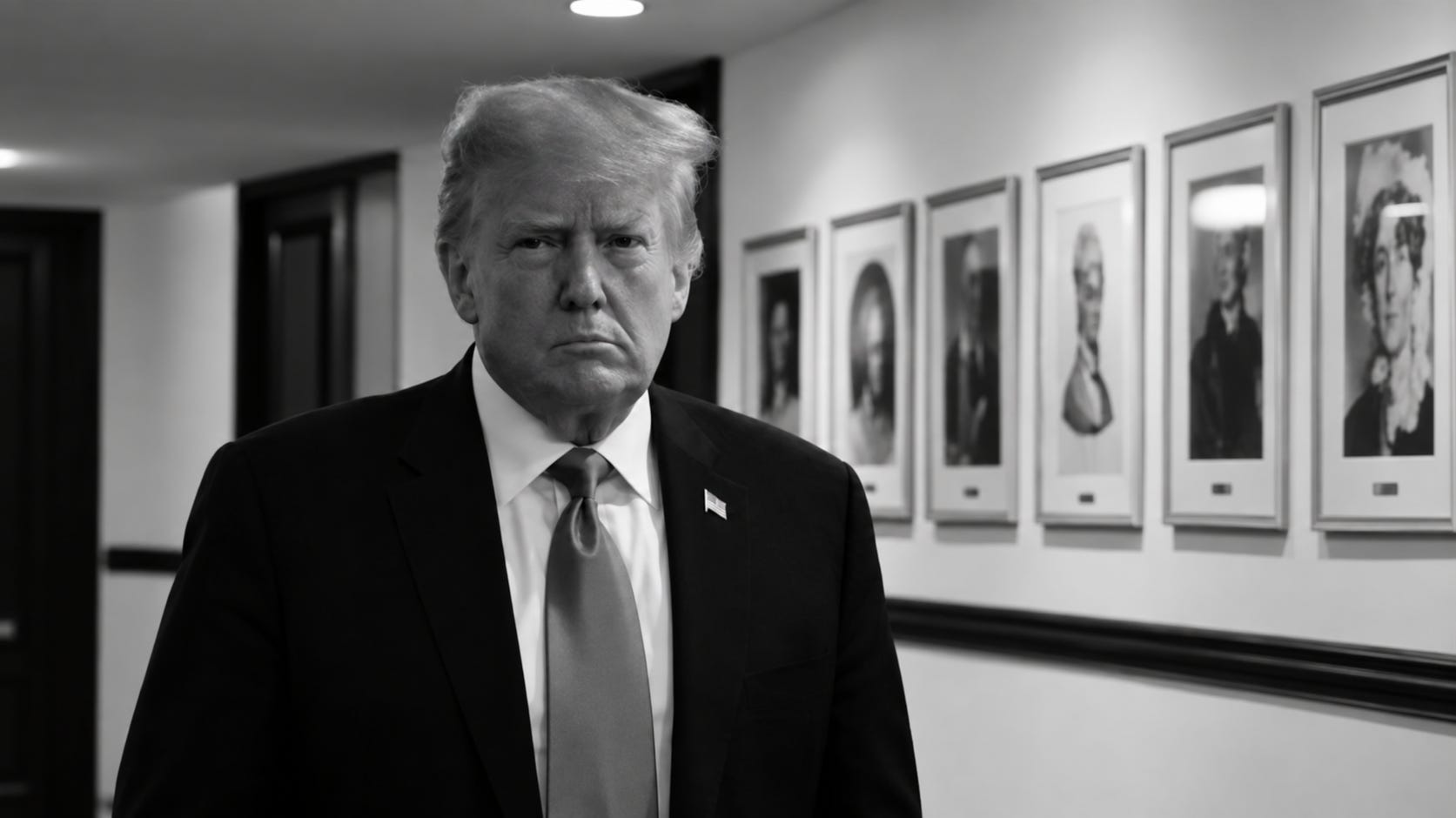
As the Trump administration fights with the press over control of the presidential message, it has tested a new government messaging format: government-funded “public service announcements” that prominently feature Donald Trump. Each carries the disclaimer that the U.S. government paid for it.
One ad is fast-paced, 30 seconds in length, and is now commonly nicknamed the “Love Me” video after the musical background drawn from the song by singer-songwriter JMSN. It presents the president as a tireless warrior committed to protecting the country from communism, socialism, and Marxism, and it praises the administration’s accomplishments in cutting taxes, defending law and order, and “reigniting American manufacturing.” A second reviews the success of the administration’s capture of Nicolas Maduro and his wife and cites Marco Rubio’s press remarks that “[p]eople need to understand that this is not a President that just talks and does letters and press conferences.… If he says he’s serious about something, he means it.” The third, “The Final Battle,” follows Trump as he walks resolutely toward the viewer, and it replays Trump’s commitments, stated at a campaign rally in 2024, to “demolish the deep state,” to “cast out the communists, Marxists and fascists,” to rout the fake news media, and more generally to “liberate America from these villains once and for all.” The campaign rally crowd can be heard cheering in the background.
The administration denies that this is anything other than a patriotic call to Americans to love the country, both lawful and fully consistent with past presidential messaging practices. Critics denounce it as a violation of federal law, and their focus has been the ban on taxpayer funding of “propaganda.” The critics have the winning argument. A more difficult question is how the law can be enforced against these violations, and how their continuing and expanded use can be stopped.
The Question of Legality
The anti-propaganda statute principally at issue is an annually enacted appropriations rider that prohibits the use of public funds “directly or indirectly, including by private contractor, for publicity or propaganda purposes within the United States not heretofore authorized by Congress.” Any violation of that statute entails a violation as well of the Antideficiency Act, because the executive branch cannot “make or authorize an expenditure or obligation exceeding an amount available in an appropriation or fund for the expenditure or obligation.”
The Government Accountability Office, an arm of Congress (then called the General Accounting Office), has interpreted “propaganda” to include 1) “self-aggrandizement, or communications tending to emphasize the importance of the agency, its officials, or the activity in question,” 2) “purely partisan” political content, and 3) “covert propaganda.” The first two categories are defined by content; the third is defined by concealment—whether the government obscures itself as the source of the self-aggrandizement or partisan commentary. GAO has sought to distinguish propaganda from other communications “to inform the public of [administration] policies, to justify its policies and to rebut attacks on its policies.” This distinction rests on the informational value of the communications.
In 2004, executive branch lawyers in the Office of Legal Counsel agreed in part with the view taken by GAO, stressing that the law’s prohibition applied to the funding of advocacy for “a particular viewpoint, not to the legitimate provision of information” about government programs or policies or the mere “promulgation of legitimate governmental information.” It found that GAO’s reading of the law to prohibit material that is “self-aggrandizing” or “purely partisan in nature” was “reasonable and valid.” However, emphasizing the distinction between the provision of information and attempts to “mold opinion,” OLC concluded that a violation of category (3)—“covert propaganda”—could not be predicated only on a failure to disclose the funding source. Even in the absence of transparency, the communication had to qualify in content as propaganda.
It should be noted that criticism of the ads has also alleged violations of the Hatch Act, which generally restricts the partisan political misuse of government influence and position. This is less sure legal ground, as discussed below, but any concern with partisan political misuse of government resources is addressed, at least for the “Final Battle” ad, by the anti-propaganda statute. Still more uncertain are any meaningful consequences of these violations.
The “Love Me” Ad
Which kind of propaganda, then, is involved in the “Love Me” ad: “self-aggrandizement” or “purely partisan” commentary? The administration denies any partisan political purpose, noting that Trump is “not on the ballot” and the ad contains no “call to action.” While the president has called on voters to “pretend” that he is on the ballot and accordingly vote for his party’s candidates, the more formal, factual view—that he is not actually up for re-election this fall and the ad makes no references to parties, voting, or elections—likely prevails here.
But the “Love Me” ad, as the appropriately chosen nickname suggests, certainly contains a massive dose of self-aggrandizement. The president is depicted throughout in what are plainly meant to be heroic postures: the musical refrain is, after all, “love me,” and the ad concludes with a rousing claim by his friend, Ultimate Fighting Championship CEO Dana White, that Trump is “the toughest, most resilient person that I’ve ever met.” The ad’s signal emphasis on the “importance” of Donald Trump within the meaning of the GAO ruling is not reasonably debatable. The references to Trump’s tax cuts and other accomplishments do not constitute the delivery of information so much as, in context and in sweeping terms, a touting of major achievements worthy of celebration. There is no usable “information” here: it is a sum-up of accomplishments and a tribute to Trump as the one responsible for them.
The president might take some comfort from the OLC lawyers’ attention to “common practice” among administrations. The Trump White House has posted to its website a claim that it is following the common practice among presidents whose administrations have sponsored ads. The problem with this line of defense is that the cases it cites are not much like “Love Me.” One example it cites, the Obama administration advertisement for the availability of Obamacare subsidies and open enrollment, provides important information for program beneficiaries. It falls clearly within the category of the legitimate provision of information about agency programs. None of the others conform to the “Love Me” model.
The Maduro Ad
The Maduro ad is also “self-aggrandizing”: it is a celebration of an achievement with emphasis (via the Rubio comments) on the personal and leadership qualities that allegedly made the achievement possible. Recall that this category of propaganda defines “self-aggrandizing” conduct with reference to any emphasis on “the importance of the agency, its officials, or the activity in question.” The emphasis of this ad is of just this kind: the Secretary of State using the Maduro capture to highlight what he wishes the public would accept about the president’s exceptional leadership. There is no new information conveyed about the U.S. operation in Venezuela. The public is simply reminded of it again in dramatic terms—along with the tribute to the president’s sterling personal qualities.
The “Final Battle” Ad
The “Final Battle” ad is based on a campaign ad and appears to be built out of the soundtrack of the president’s speech at a 2024 campaign rally. In the background are the cheers of the crowd. And the anti-propaganda law does not require an ad subject to its prohibition to contain specific electioneering language or imagery, like “Vote Republican” appeals uttered by the president or run in an on-screen chyron. The GAO years ago acknowledged that “the lines separating the nonpolitical from the political cannot be precisely drawn,” but also that the law applies to a communication “so political in nature that it is not in furtherance of the purpose for which Government funds were appropriated.” (Emphasis mine.)
How could the administration suggest that an ad constructed out of a campaign speech is not “political in nature” and not well outside the bounds of what Congress believed it had authorized funds to be used for? If there is no precedent for the application of the law in these circumstances, that is because there is no precedent in practice: I am not aware of any president who has done this before.
The Hatch Act speaks to the issue less clearly, mainly because it excepts from its strictures the president and vice president. There may be issues for the officials who aided the president in the development and placement of this ad, but their liability raises complicated questions that I do not address here.
What are the consequences of a legal violation?
If the ads violate federal law, the likelihood of legal enforcement is remote. The GAO has never found a violation of the ban on “self-aggrandizement” propaganda, and, addressing the question of partisan content, it merely wagged its finger at the Bush administration’s use of a communications consultant to do a media analysis of press coverage of the administration and the Republican Party’s signature “No Child Left Behind” education reform initiative. To my knowledge, the Justice Department has never brought a case for criminal violation of the Antideficiency Act, and this Department will not be the first one to do so.
The president can tighten his defenses against any legal attack by directing OLC to revisit the question of the statute’s application: on other issues, OLC has proven reliably accommodating. The GAO remains the alternative authority, but it is an arm of Congress and its “decisions are not binding” on the executive branch, except that the Office of Management and Budget “will work with the [executive branch] agency to determine whether a violation has, in fact, occurred.” Not, in this administration’s OMB, a promising path for a legal resolution on the merits. The Trump White House can fortify in these ways its defenses. If all else fails, the president stands ready to deploy the pardon power.
What’s Next
Congress faces a major legal and policy challenge in giving any teeth to the ban on government-funded propaganda. The information/opinion-influencing distinction is a difficult one to apply to presidential communications that may be less self-aggrandizing than “Love Me” or the Maduro ad, and less partisan than “Final Battle” but still provocatively propagandistic.
Moreover, administrations of both parties have a major stake in preserving maximum flexibility and the potential for innovation in creating effective messages. As the media environment undergoes steady and major transformations, White Houses endeavor to keep pace, and as political scientist George C. Edwards III has written, “new modes of communication offer an opportunity to bypass the press and communicate directly with the public.” The positive framing of presidential messages, adapted to a variety of platforms, may not achieve the outsized dimensions of these crude ads, but presidents will strive hard to cast themselves and their actions, in direct communications with the public, in the most positive light.
But the Trump presidency shows how far a government can go in “informing” the public in what, by any commonsense understanding of the law’s aims, falls on the “propaganda” side of the line. Trump is always selling himself. The celebration of his person is woven into his very insistent claim to presidential greatness. The effort to place his name on public buildings, the reconstruction of the White House, and other monument-building projects around the capital are of a piece with these “public service announcements.” Among the characteristics for which this administration is noted, “self-aggrandizement” must rank close to the top of the list.
Congress does have tools to discourage the use of taxpayer funds for ads like “Love Me,” the Maduro ad, and “Final Battle.” It could conduct aggressive oversight of, and investigation into, these uses of public money. It could exact some pain from the administration, as with threatened funding cutoffs for particular agencies, until it desisted from grossly self-congratulatory messages like these.
There is maybe a flicker of hope that the Trump administration has crossed a line to such an extent that some Republicans can join Democrats to map out a response to protect against a rising flood of taxpayer-funded communications of this kind. This much both parties know: if this is the wave of the future, both can and will ride it, but the electorate will not likely abide the use of its tax dollars for ads like these. And, beyond the politics, the National Review’s Andrew McCarthy has rightly pointed out in writing about the president’s blatant self-enrichment in office: “Regardless of whether [presidential] misconduct is illegal or “merely” a sleazy betrayal of the public trust, the Constitution vests Congress alone with the capacity, and the duty, to address executive misconduct.”