


Please click here to opt in to receive via email our Roundup—brief daily summaries of news developments and commentary related to executive power.
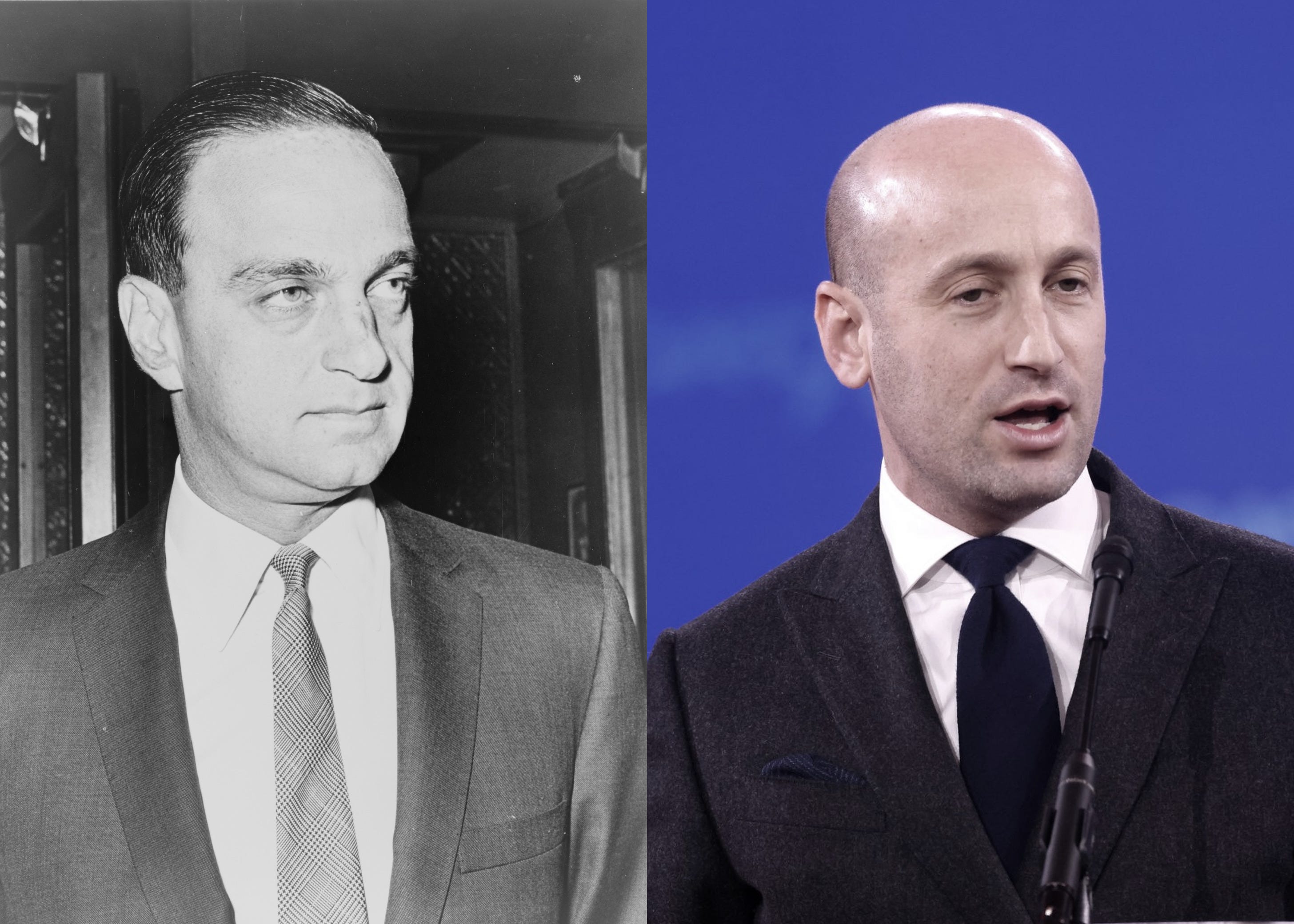
Kai Bird’s richly detailed and absorbing biography of Roy Cohn, the lawyer Donald Trump much admired, devotes a chapter to the relationship and what so impressed Trump about his counsel. Bird, who wrote the book with Susan Goldmark, emphasizes the fabled playbook routinely employed by Cohn in pursuit of victory: never concede ground or admit defeat, always counterattack, deploy blatant falsehoods and inflammatory rhetoric as necessary and without shame. Cohn’s lawyering, such as it was, was of the “ends justify the means” variety: “I view an end…more important to me than the intermediate steps.” He was a “fixer” more than a lawyer in any formal (or ethical) sense of the term. He prided himself on absolute loyalty to his clientele and friends, and it was loyalty and ruthlessness that Trump lauded as among Cohn’s signature qualities. He was “brutal,” Trump has recalled, and “very vicious to others in his protection of me.”
In Trump’s first term, the president famously asked in frustration: “Where’s my Roy Cohn?” Now, in the aftermath of calamitous midterms, Trump has concluded he needs a new chief of staff, and he has found his Cohn: Stephen Miller. Trump has chosen for the next two years of his term a Roy Cohn presidency, and Miller is the natural selection for this purpose. The selection of Miller points toward a turbulent course defined by confrontational politics built around baseless claims of presidential power and a reckless, divisive rhetoric to go with it. It also carries with it the high prospect of failure.
Trump lauds in Miller the Cohn-like qualities he has been looking for. The day of the announcement, he singled out Miller for being “very loyal” and “a great fighter.” In his first speech since being named chief of staff, Miller pledged to the president “my absolute loyalty, my unwavering commitment and my total devotion to your success and the success of this country.”
Miller has established his “unwavering loyalty” over his years of service to Trump. Like Cohn, Miller routinely delivers a give-no-quarter defense of Trump and harsh derogation of his boss’s perceived enemies. He has characterized the Democratic Party as “a domestic extremist organization” and rulings against the administration on controversial immigration policies as the work of “radical rogue” and “communist” judges who are waging “war” against the president. “The leftist,” he has said, is “fundamentally motivated by envy, by hatred, by jealousy.” By contrast, the president he serves “saved America,” which without him “would not exist right now.” The administration of which he is a part is in “a fight to save civilization.”
Miller has demonstrated that, like Cohn, he will consider, if not advise, whatever it takes for the president to win his policy battles. He is reportedly committed to extreme positions on presidential power. According to press accounts, he has argued within the White House for suspending resort to writs of habeas corpus to protect against the immigrant “invasion”—a possibility he also raised publicly—and for deploying troops under the Insurrection Act to suppress protests against the administration’s immigration policy. He has also “personally drafted or edited nearly every executive order Trump has signed,” a number of which, such as the attempt to assert control over federal election rules, courts have found to have exceeded the president’s constitutional authority. The Wall Street Journal reports that he is now working with another architect of this use of executive orders, Office of Management and Budget Director Russell Vought, to “chart a second-term agenda with an emphasis on executive actions that don’t require congressional approval.” Or, more to the point, it will be an agenda that they will claim needs no such approval.
The political and policy risk for Trump in a Roy Cohn presidency is failure. What is most striking in the Bird account of Cohn’s career, and the parallels with Trump, is the story of successful rise and ignominious downfall. Cohn would score a win here and there, often secured by illegal or questionable means. His youthful rise in national politics crashed with his dismissal from his role as counsel to Joe McCarthy, and his legal career was riddled with financial stresses, serious legal problems, and, in the end, disbarment. Cohn, like Trump, was a large personality who liked to perform on the public stage and did so with considerable success. His deep flaws eventually caught up with him, and this second term and the midterm elections so far suggest that this may be the fate awaiting his former client Donald Trump.
A Roy Cohn presidency over the next two years driven by Miller as chief of staff seems destined to accelerate this failure. The weakness at the core of a Roy Cohn politics is that it is an antipolitics. It scorns the hard work of managing, not escalating, conflicts with adversaries, valorizing instead a strategy of attacks and counterattacks with a rejection of legal constraints, respect for facts, and civil debate. As I have written elsewhere:
In antipolitics, political activity as a means of reconciling diverse opinions and interests is seen as an abject surrender of principle. It is replaced instead by a bullying disregard for the views of the opposition, which is not just to be defeated at the polls but utterly vanquished. Partisans should control elections, all the better to ensure the desired results, and the rule of law, disdained as a political tool, is ready at hand for use against adversaries, to punish and weaken them.
Trump has pursued this antipolitics in his second term, and the midterms might have suggested to him that it was a factor contributing to historic losses. The Miller appointment shows that he has decided to stay the course.
In January 2025, Jack and I wrote that “[t]he Trump 2.0 administration is charging ahead with a ‘shock and awe’ executive order program enhanced by public pronouncements of desire to exercise executive power in the extreme. Far from absorbing the experiences of Trump 1.0, Trump 2.0 is doubling down. We predict it will not end close to as well as the new president imagines and hopes.” It has not, so far in this term, ended well, and putting Stephen Miller to work with the Cohn playbook will not improve matters.
