


Please click here to opt in to receive via email our Roundup—brief daily summaries of news developments and commentary related to executive power.
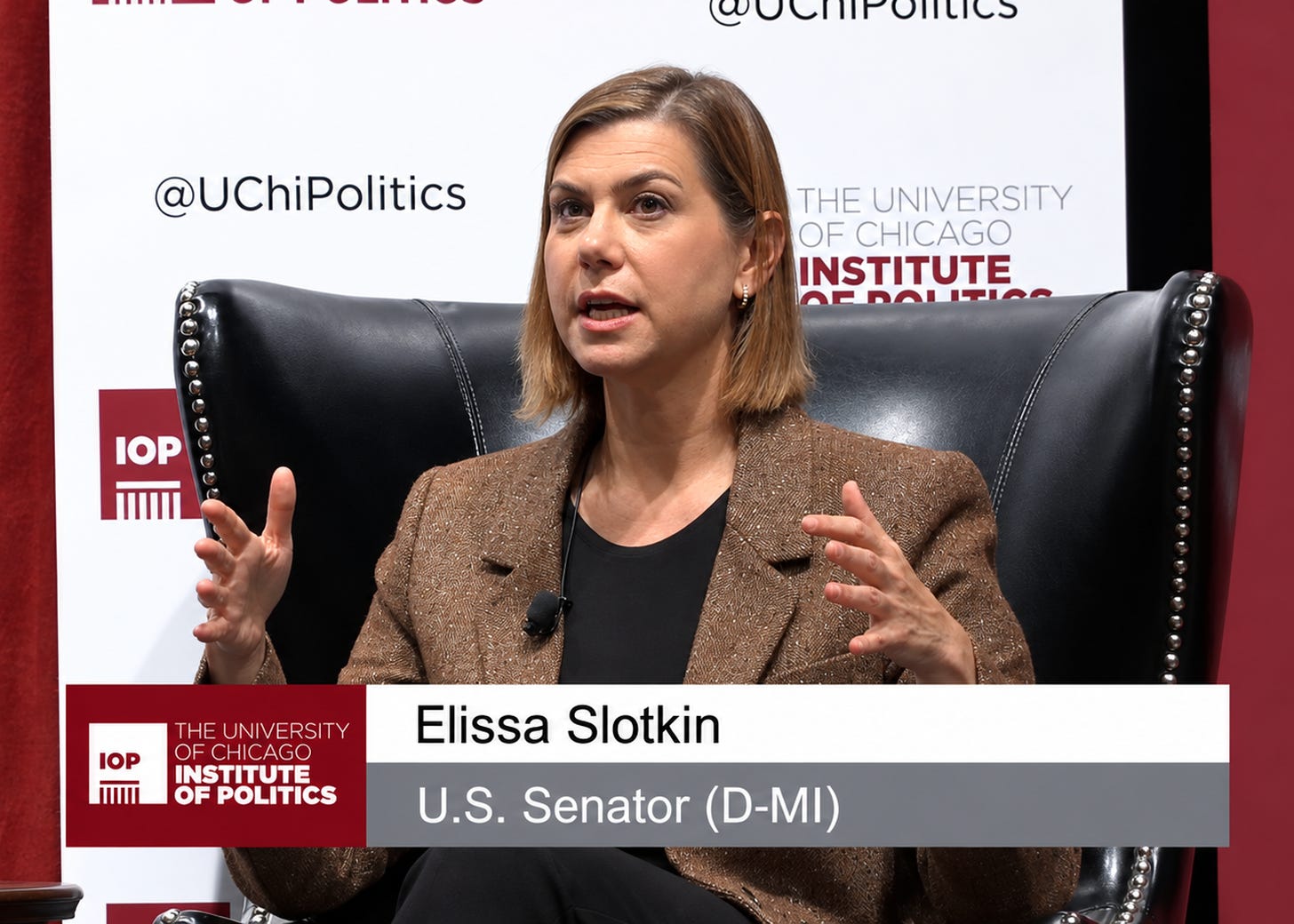
Michigan Senator Elissa Slotkin was one of six Democratic members of Congress whom the Trump Justice Department—at the president’s urging—tried to indict last winter over a video that reminded members of the armed services about their legal duty to disobey illegal orders. The baseless effort failed at the grand jury stage. It was one of hundreds of examples of Trump 2.0’s weaponization of the legal system.
At an event at the University of Chicago on Oct. 13, Senator Slotkin suggested accountability for “the people who enabled” Trump in order to deter “people coming out of school” from working for the Trump administration. “I want them to be like, Lord, that might be buying myself a ton of problems that I don’t want, and so let me avoid participating in that,” Slotkin said. “I want that deterrence message sent.”
A clip of the claim went viral Saturday and set off a firestorm of indignant, hypocritical reactions from Republicans and Trump supporters, who accused her of weaponization and authoritarian tactics. The episode was a window into our bubbled, mutually recriminatory, tit-for-tat, weaponizing political/legal culture, and a preview of what’s ahead.
Trump and Deterrence
Donald Trump has long believed in escalatory tit-for-tat to deter enemies. “They hit me and I hit them back harder and they disappear,” he said in 2016, during his first presidential run, explaining a philosophy formed as a New York real estate developer.
Trump also understands that harsh retaliation deters third parties. “When people wrong you, go after those people, because it is a good feeling and because other people will see you doing it,” Trump wrote in his 2008 book Think Big. He has always exercised executive power, corporate and governmental, this way.
And this philosophy has guided his second administration. “We want the bureaucrats to be traumatically affected,” said Project 2025 architect Russell Vought in 2023. “When they wake up in the morning, we want them to not want to go to work because they are increasingly viewed as the villains.” He added: “We want to put them in trauma.”
That is what Vought has done against the hated Deep State that Trumpers think tried to deep-six Trump’s first term. “Traumatized” is a word I often hear to describe the bureaucrats beaten down in or run out of Trump 2.0. The aims of trauma are to keep the bureaucrats in line, to frustrate them so much that they will leave, and to reduce the attractiveness of their jobs in the future.
Deterrence by trauma has been the operating philosophy of the Trump weaponization campaign far beyond the bureaucracy. The aim has been to use every tool of government power—prosecutions, investigations, raids, arrests, firings, funding and benefit cutoffs, threats of all of these things, other sorts of threats, and harsh government speech that riles up crowds of minatory supporters—in an effort to impose as much pain as possible on enemies, broadly conceived.
Targets have included Democratic members of Congress, blue states, and Democratic-run cities; former officials who crossed Trump in any way imaginable; disloyal Republicans; retired generals, national security advisors, and intelligence officials deemed disloyal or insufficiently loyal; the progressive power centers that Trump and supporters (and many conservatives) have seen as long-term enemies, including elite universities, progressive Big Law, and media powers; individual journalists; lower courts; progressive NGOs and philanthropists; corporate adversaries of various sorts; and many more.
Little of this can be justified as good-faith executive branch law execution. Most of it has been abusive. A good deal of it is illegal, and has in many instances been declared so by courts.
But illegality, including illegality declared by courts, often doesn’t matter. The aims of the abuse are (i) hateful vengeance (“it is a good feeling”), (ii) retribution for perceived wrongs (“go after those people”), or (iii) deterrence, against enemies and future foes (“other people will see you doing it”).
One of the Trump administration’s devilish insights is that all of these aims, including the infliction of trauma from “going after” people, can sometimes be achieved by illegal action. Trump has diminished Big Law opposition to his administration through his illegal law firm orders. He has achieved major ideological goals on campus with his illegal university lawsuits and threats. The media has been somewhat less cowed, but nonetheless cowed a bit. And so on.
Going forward, after Trump, law firms, universities, the media, and so many others will have to consider the possibilities of future Trump-like punishment if they revert in the direction of pre-2025 behavior. This consideration will deter some, perhaps many. Going forward, after Trump, those who want careers as civil servants in government will have to consider the possibility of future Trump-like trauma. This consideration, too, may deter as measured against the pre-2025 baseline. And a future Democratic administration will have to consider such future retaliation if it imposes accountability on Trump or his subordinates for their abuses in office. (More on this below.)
I am confident that a good chunk of the Trump weaponization strategy is to achieve deterrence of just these sorts. This conclusion is obvious from the patterns of behavior, from what Trump supporters say, and from what we know about Trump’s philosophy. People inside the administration have told me that this is a primary goal.
The Next Democratic Administration
Which brings me to Senator Slotkin’s remarks. She counseled a version of the Trump operating philosophy: hold people—including non-senior government officials—accountable so that they and everyone watching will think twice about committing the undesired acts.
Senator Slotkin might have limited her remarks to the need for accountability for those who committed Trump-era abuses. But she brought in the language of the Trump deterrence philosophy and took it to a new place by suggesting on a college campus that she wanted to make an example of lower-level Trump enablers to deter college students from working for the Trump administration.
There is a large, difficult question about how the next Democratic administration should think about accountability for the endless executive branch abuses and rampant illegality that have permeated the Trump administration. The forms of abuse and illegality have been so broad-based that it is hard to know where to start or how to proceed. There is also a large and difficult question about how the next Democratic administration will use all of the many tools of the weaponizing unitary executive that it will inherit from Trump against its Trumpian enemies, and what new tools it might wield.
And then there is the fact that what looks like accountability in one bubble looks like weaponization in another.
The Trump team, with some justification, saw many of the actions against Trump and his allies from 2016–2024 as illegal, norm-breaking, or abusive. I am thinking about the investigation of his presidential campaign by the Obama (and later Trump) administration FBI that was marred by irregularities, norm violations, and illegal acts; the inconclusive but disabling (and in some respects norm-breaking) Mueller investigation; the Biden administration’s appointment of Jack Smith, a famously push-the-legal-envelope-too-far prosecutor, as special counsel to pursue Biden’s opponent at the outset of the presidential campaign; Smith’s norm-breaking election year rush to trial in the edgy January 6 case; and the related Democratic-party-complex legal actions against Trump (and some in his administration) in various states, several of which were legally dubious.
All of these events were enormously traumatic for the people involved—for so many in the first Trump administration, and especially, I imagine, for former Trump officials like Jeff Clark and John Eastman, who are being hounded out of the profession for their alleged bad acts advising the president. This trauma, this anger, and other long-tail resentments of various sorts are what fueled the Trump deluge in 2025 (and the planning for the deluge before then).
Many Democrats and other Trump opponents saw all of these actions against Trump and his subordinates as needed accountability to redress legal violations. Trump and his team did terrible things, and the rule of law needed to be vindicated. Indeed, the rule of law would be diminished, they argued, if Trump were not pursued vigorously with every tool. This philosophy pervaded anti-Trump sentiment in 2024.
And yet, as predicted, it didn’t work out so well. The rule of law, and the Department of Justice, were left in a much worse place due to the many failed efforts to decapitate Trump through legal maneuvers. Legal accountability for senior public officials in a prior administration—especially the sitting administration’s leading political opponent—demands prudence and exquisite judgment. That prudence and judgment were largely absent during the Biden years.
There is a growing element in the Democratic Party that wants to go much harder next time. Former National Security Advisor Susan Rice, for example, said in February that Democrats once in power would punish the companies and institutions that have collaborated with Trump. “If these corporations think that the Democrats, when they come back in power, are going to play by the old rules…they’ve got another thing coming,” she said. “This is not going to be an instance of forgive and forget. It’s not going to end well for them.” She added: “Democrats have had a belly full, and we’re not going to play by the old set of rules… but we’re not going to be suckers.” Rice and those who share her view surely would apply this logic to “collaborators” inside the administration.
In light of what Trump 2.0 has done, this is not an irrational view. It is an escalatory response to Trump’s escalation. And if implemented, it would put all of the people and institutions coerced or deterred by Trump in a vice, since they would be on the receiving end of the same forces coming from the other direction. It is hard to predict who will win or lose in such escalating tit-for-tat, just as it is hard to predict who wins an arms race. (Sometimes everyone loses.) The important development here is that Slotkin’s comment may indicate that the Rice view is beginning to take hold in the more moderate camp.
I understand but do not share Rice’s view. I believe accountability for Trump 2.0 should focus first and primarily on transparency, i.e., figuring out what happened, not just in Trump’s abuses of government, but also in his and his family’s extraordinarily corrupt financial aggrandizement—and yes, that includes finding out who enabled, and benefited from, all of these things, and how.
I am less enthusiastic about legal redress. Prosecutions are going to be hard because Trump is going to pardon everyone he can think of who might possibly be implicated in any Democratic investigation. This will be an historic abuse of the pardon power, but it could be a blessing in disguise if it preempts another round of attempted prosecutions.
Yet pardons won’t stop other forms of accountability, including legal accountability via private actions and in states and other means. And there are many ways short of legal accountability that a Democratic administration could seek to make Trump officials pariahs in various circles. I saw this happen to Bush administration officials after 2008, and it wasn’t pretty. I fear it will be much worse after Trump 2.0. As will the round after that.
The Trumper Reaction
While I don’t like what Slotkin said, the indignant reactions by Trump supporters were astonishing in their hypocrisy, even by Washington standards. Consider just a few of many examples:
Scott Kupor, the Director of the U.S. Office of Personnel Management, accused Slotkin of “endorsing political prosecutions to dissuade patriotic Americans from serving their country.” This is exactly what the Trump administration has done on many occasions (and Kupor’s office has dissuaded many patriotic Americans from serving, though not through prosecutions).
FTC Commissioner Mark Meador expressed disappointment that Chicago “play[ed] host to such dangerous rhetoric,” when the administration’s rhetoric and actions, about which he is necessarily silent, have been much worse.
Representative Lisa McClain said Slotkin’s call to “Weaponize politics and threaten prosecution for those working on the ‘wrong’ side” sent a chilling message. Representative McClain has been silent about the Trump administration doing just that in previously unimagined ways.
Representative Nancy Mace said “Senator Slotkin is a literal, walking and talking, ‘threat to democracy,’” but of course does not think it a problem that the Trump administration has done what Slotkin hinted at.
It is pretty clear that this hypocritical piling on of Senator Slotkin is a coordinated message designed to stir up anemic pro-Trump voters in the upcoming elections. And Slotkin fired back, focusing on accountability (but, notably, not deterrence), and referenced her own experience with Trump weaponization. “Spare me the pearl-clutching — especially from Republican Members of Congress and online MAGA grifters who have cheered President Trump’s weaponization of the government against those he doesn’t like, as recently as last week,” she wrote.
Despite the obvious hypocrisy in the Republican remarks, many on the Trump side really believe that the Democrats are just as bad, if not much worse, because they sought to decapitate Trump in his first term and to keep him off the ballot or weaken him considerably through lawfare in 2024.
Put another way, I don’t think Vice President Vance was being disingenuous at a Turning Point event a year ago when he said, in response to a question about whether Trump tactics could be turned on Trump supporters by a future administration:
[I]t’s going to sound like I’m being sarcastic, . . . but when you talk about what could another administration do, to take a wild, hypothetical example, totally off the top of my head, what if Joe Biden sent the Federal Bureau of Investigation to start arresting his political opponents? Okay? So here’s something that I want conservatives, I want every conservative to remember, it’s an important part of my entire political philosophy, is we cannot be afraid to do something because the left might do it in the future. The left is already going to do it, regardless of whether we do it. That is the takeaway of the last 40 years. . . . What I’m worried about, frankly, is what the far left already did with American law enforcement, and that is the thing that we have to prevent against. And the answer to that question, is you make sure that people who did it face penalties for using the federal power against American citizens. And by the way, that’s exactly what we’re trying to do.
This is not totally coherent, but the basic idea seems to be that the Biden administration wielded “federal power against American citizens” (i.e., Trump and his supporters) illegitimately and the Trump right is thus justified in imposing “penalties” to “prevent against” it happening again. This is the Trump deterrence strategy internalized so that the ends justify the means. This worldview pervades the Trump administration. It is a worldview that, very cynically but not entirely in bad faith, creates a Weaponization Working Group to redress and end weaponization by engaging in weaponization.
Where This Leaves Us
I don’t have prescriptions. There were very good reasons for the long-standing norm of not prosecuting high-level political rivals or using overt legal tools to damage and try to block a presidential candidate in an election year. Democrats broke that norm, which they believed was justified by Trump’s horrific actions. And they further believed that the norm brought its own costs in allowing a law-indifferent and abusive president to not be held to account. The Trump side saw this all as norm-busting and in bad faith.
Trump won the election and could have stopped the cycle. But that was contrary to his vengeful nature and, in any event, would have been seen by his side as unilateral disarmament. And so he engaged in astonishingly harsh and broad retaliation for what the Biden administration did, in order to deter rivals on many dimensions. The Democrats are now contemplating whether and how to respond when they gain power. The incentive for brutal retaliation will be overwhelming, especially since it will be argued, just as Vance argued, that the other side has already done it, will do it again if possible, and thus must be maximally deterred.
And so on.
It’s a bleak future.
