


On August 10 the Office of Legal Counsel issued a strange opinion to the White House Counsel about the presidential communications component of executive privilege. It is strange because the White House asked whether privilege protects presidential communications with private advisers but did not, according to OLC, “indicate a specific adviser or subject matter.” It is strange because OLC’s foreordained answer to this abstract question—yes, in theory, with qualifications—does not serve any obviously useful purpose. And it is strange, finally, because the opinion exaggerates the state of the law in a way that highlights the absence of precedent for its conclusion.
Which raises the question: Why did the White House ask, and why did OLC publish? We are not sure.
Motivations
The OLC opinion was surely coordinated within DOJ and was almost certainly written with two events in mind.
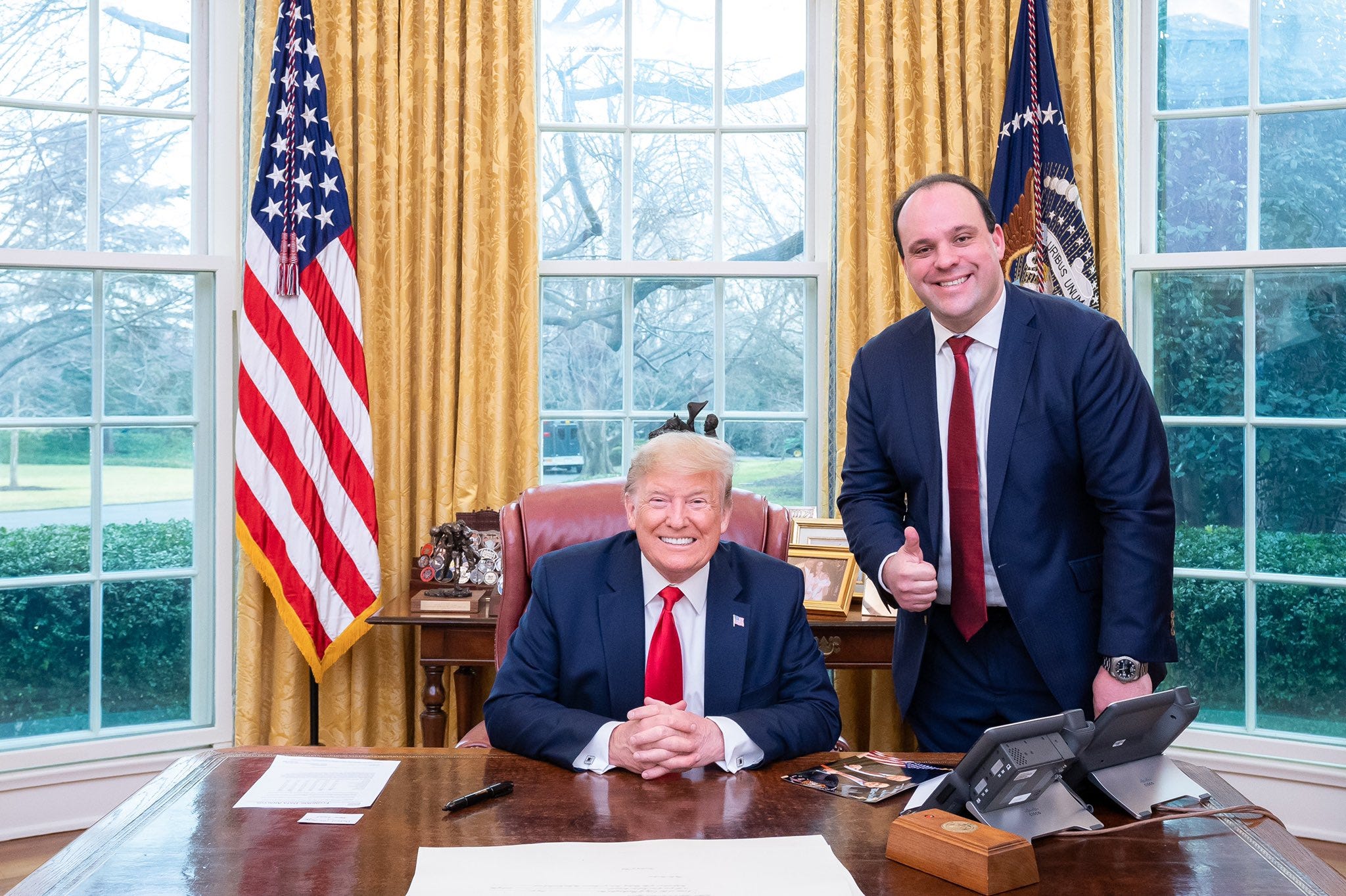
The first event is an American Bar Association lawsuit against executive branch officials and agencies challenging the constitutionality of the Trump administration’s “Intimidation Policy” against major law firms over alleged ideologically slanted hiring and pro bono practices. The ABA issued subpoenas to Trump’s personal lawyer and adviser, Boris Epshteyn, seeking documents concerning communications with the relevant firms or related to the executive orders and settlements associated with the policy, as well as attendance at a deposition.
In response, the Department of Justice moved to quash the subpoenas on the ground that they in part sought information protected by the presidential communications component of executive privilege. At the same time, it declined to confirm or deny “whether the President even received advice from any third party,” including Epshteyn, in connection with the executive orders. The government also asserted that the attorney-client privilege would “completely and totally” shield from disclosure Trump’s communications with an adviser who was also one of the president’s attorneys. Finally, the administration subpoenaed the targeted firms for records and testimony involving Epshteyn, including “all communications… sent to Boris Epshteyn, received from Boris Epshteyn, or participated in with Boris Epshteyn.”
The second event is one the OLC opinion anticipates: a suite of investigations Democrats plan to conduct if they win majority status in at least one chamber of Congress. Democrats plan to focus on the testimony of non-governmental persons who have had various dealings with the Trump administration on the theory that “investigating private companies and outside financial players will prove more fruitful than directly confronting a White House they expect to resist oversight.” The range of inquiries and third-party witnesses is potentially vast, and includes, to name just a few, individuals involved in the president’s crypto and other national and international business interests; donors to the White House ballroom construction; contractors for the renovation of the reflecting pool and construction in the capital; private prison operators and security firms that have contracts with the Department of Homeland Security; and commodity traders involved in the government’s sale of Venezuelan oil.
The Presidential Communications Privilege
“The doctrine of executive privilege,” OLC wrote in 1982, “defines the constitutional authority of the Executive Branch to protect documents or information in its possession from public disclosure and from the compulsory process of the Legislative and Judicial Branches.” One component of the doctrine, in the words of United States v. Nixon, is the “privilege of confidentiality of Presidential communications.” As the D.C. Circuit explained in an important decision, In re Sealed Case, the privilege applies to “documents or other materials that reflect presidential decisionmaking and deliberations and that the President believes should remain confidential” but is qualified and thus can be overcome by “an adequate showing of need.” The privilege is limited to communications connected to the performance of presidential responsibilities.
In re Sealed Case held that this privilege extends beyond “direct communications with the President” to “communications that involve his chief advisers,” including “communications which these advisers solicited and received from others as well as those they authored themselves.” The court did not explain what it meant by “others” and did not consider or address the problem of private parties. It acknowledged that its “extension” of the privilege, “unless carefully circumscribed to accomplish the purposes of the privilege, could pose a significant risk of expanding to a large swath of the executive branch a privilege that is bottomed on a recognition of the unique role of the President.” It ruled that “to limit this risk, the presidential communications privilege should be construed as narrowly as is consistent with ensuring that the confidentiality of the President’s decisionmaking process is adequately protected.”
The OLC Opinion
The OLC opinion notes correctly that presidents have often sought advice from persons outside the executive branch in connection with presidential decisionmaking. It argues that the purposes of the privilege—to ensure that the president receives candid and comprehensive advice related to presidential decisionmaking—are implicated by, and thus should extend to, advice received from private parties. OLC then claims that “courts have recognized that the privilege applies to communications with private advisers” and reiterates that “[p]recedent from . . . courts confirms that executive privilege extends to presidential communications with private advisers.”
These are misleading statements. No judicial decision “recognizes” or establishes a “precedent” that the presidential communications privilege extends to communications with private advisers. In re Sealed Case did not consider the issue and one can view its dicta on various matters to cut both for and against the privilege in that context. AAPS v. Clinton, another D.C. Circuit opinion, invoked the privilege to avoid a constitutional question in construing the Federal Advisory Committee Act to not reach a task force of government officials chaired by the First Lady. It stated that a “statute interfering with a President’s ability to seek advice directly from private citizens as a group . . . raises Article II concerns,” but did not consider or address whether such communications could be withheld from compulsory process. Other decisions OLC cites are even further from its legal conclusion, and OLC doesn’t discuss precedents cutting the other way. When DOJ in a 2007 opinion concluded that the presidential communications privilege extended to parties “outside the Executive Branch” (mainly focused on members of Congress), it relied on In re Sealed Case but did not suggest that Sealed Case or any other decision “recognizes” or establishes a “precedent” in support of the presidential communications privilege. The issue remains open in the judiciary.
OLC correctly notes three qualifications to its abstract analysis. First, the privilege is “limited to communications in performance of a president’s responsibilities of his office and made in the process of shaping policies and making decisions” (cleaned up). Second, the privilege applies “only to communications with the President, or communications solicited and received by the President or his direct advisers.” Third, “the privilege requires the communication to have been confidential at the time of its creation and that the President continue to treat it as such.” These stated conditions, offered as “a general matter,” highlight the tentative and hypothetical nature of the OLC analysis and its dim applicability to any real-world controversy.
Why Seek and Why Publish?
It is a bit of a mystery why the White House Counsel solicited this OLC opinion on a highly abstract hypothetical question and why either office thought it a good idea to publish an opinion that exaggerates the law on the extension of the presidential communications privilege to private advisers.
On the solicitation, the White House is clearly concerned about congressional investigations after the midterms. The Counsel’s Office has, for example, given “private briefings to the administration’s political appointees on how to best prepare for congressional oversight” in anticipation of the possible midterm results. The OLC opinion considers the applicability of its analysis to congressional disclosures. Perhaps the Counsel thinks the opinion will help on privilege claims when Congress seeks third-party testimony and documents.
But the OLC opinion will not help, and not just because its analysis is so hypothetical. It will at most furnish a citation in a letter or a talking point on the House floor. Democrats will give it no weight. And this is not unusual. Neither party in Congress cares what the president’s lawyers say on privilege issues. No OLC opinion has prevented Congress from holding an administration official in contempt for refusing, on privilege grounds, to comply with a subpoena for documents or testimony. In recent years, a Republican House held the attorneys general of both the Obama and Biden administrations in contempt despite supportive DOJ opinions. A Democratic House will give Trump’s OLC no more weight.
Nor do OLC opinions of this sort carry any weight in the federal judiciary. Occasionally courts treat an OLC opinion as evidence supporting deference based on “a consistent course of agency interpretation” of a federal statute or regulation, which is not implicated here. And OLC opinions and practices can be relevant when federal courts believe a longstanding executive branch practice of action and interpretation is relevant to a constitutional issue. The OLC opinion invokes this principle for the existence of executive privilege, which courts have long recognized, and perhaps for the fact that presidents have long consulted private parties, which is well known and says nothing about privilege. But the principle has no bearing on the application of the presidential communications privilege to private parties, on which there is no longstanding practice, assuming such practice is relevant. There is thus no basis for courts to defer here.
And beyond its exaggeration of the state of the law, there is an administration-specific reason why this OLC opinion will not be taken seriously by courts. Whatever credibility OLC might have had with outsiders in another administration as an interpreter of Article II—a contested matter—OLC in Trump 2.0 can have no credibility outside the executive branch. This is not a comment on the work of OLC. Rather, it follows from the Trump administration’s conception of presidential power.
The attorney general just a few days ago declined to state that DOJ is independent of the president. This is true as a constitutional matter. It is also true that Article II gives the president ultimate authority to interpret law for the executive branch. Presidents since Watergate, and even before, established functional forms of DOJ independence because they thought it served the aims of the presidency. Of relevance here, presidents before Trump 2.0 delegated their legal interpretive power to subordinate government lawyers, including in OLC, and expected them to offer candid legal advice. As one of us once wrote, “Presidents embraced this arrangement because legal compliance demands it and because systemic inattention to law leads to bad policy or undesirable political or legal risk.” These forms of quasi-independence, subject ultimately to a rare presidential check, were important to OLC’s credibility. So was its practice—sometimes in opinions, more often informally—of advising that a presidential course of action is unlawful or carries significant legal risk.
But the Trump 2.0 administration has chosen a different course. It has demanded fierce personal loyalty to the president and his decisions as a criterion for hiring senior government lawyers. It has removed, pressured, or marginalized government lawyers who disagree with or stray from the White House party line. And it has issued directives to formalize the elimination of independent lawyerly judgment.
The main such directive says that the President and attorney general, OLC’s direct boss, “shall provide authoritative interpretations of law for the executive branch,” and adds that the AG is “subject to the President’s supervision and control.” But the president doesn’t care about law (or thinks anything he does is lawful). And the attorney general has made plain that he is a yes-sayer and that the Justice Department in its advisory function will not object to anything of any importance to the president or on which the president purports to have legal views.
Then-Acting Deputy Attorney General Emil Bove explained DOJ’s view in his 2025 letter firing Acting U.S. Attorney Danielle Sassoon: “You lost sight of the oath that you took when you started at the Department of Justice by suggesting that you retain discretion to interpret the Constitution in a manner inconsistent with the policies of a democratically elected President and a Senate-confirmed Attorney General.” Even if this is not true in every instance, it is the official policy of the administration, so it is true in appearance, which is enough by itself to wreck OLC’s outside credibility in its advisory function to the White House.
The administration may have nonetheless thought it would be useful to have on the books even a weak and abstract OLC opinion on the extension of the privilege to protect communications with private parties in an effort to generate a pattern of executive branch practice on the issue. But as noted, it is too late in the day, and this opinion too hypothetical, to achieve that or any other useful end that we can discern.
The Looming Interim Order Battle
It is the president’s prerogative to ask federal courts for a novel extension of the presidential communications privilege, as happened in In re Sealed Case. But that, and not application of recognized precedent, is what the government is seeking in the ABA case. We do not have space here to address the merits of the government’s presidential communications claim. The issue is complex—far more complex than OLC’s one-sided analysis lets on. And the stakes travel far beyond the ABA dispute.
The White House is gutting the civil service ranks while relying on a private advisory network far beyond past “kitchen cabinets” or routine consultation of trusted outside advisers. Given the deeply privatized character of this administration—from diplomacy to every form of domestic policy to private fundraising for pet projects, and on and on—the extension of the privilege to include communications with outside private “advisers” goes to the nature of the regime. The answer to the privilege question thus has enormous consequences for the possibility of accountability for this administration.
The answer for a very long time will almost certainly depend on a Supreme Court interim order ruling, perhaps in the ABA case. Trump was able to run out the clock on major separation-of-powers disputes in Trump 1.0 because the administration won the relevant interim orders battles. This issue could turn out to be the major interim order fight of 2026.
