


Please click here to opt in to receive via email our Roundup—brief daily summaries of news developments and commentary related to executive power.
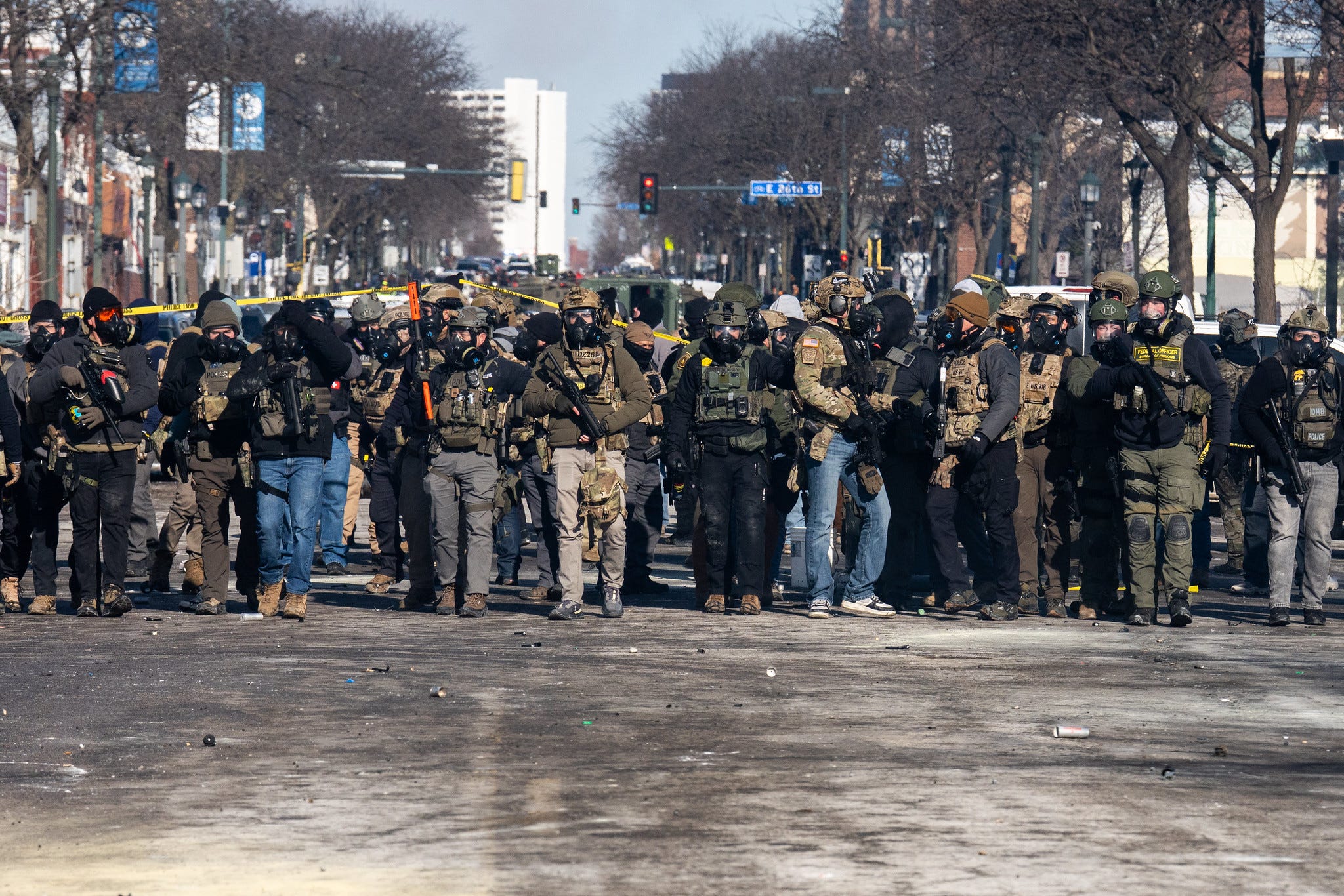
President Trump yesterday responded to the uproar over ICE operations in Minnesota by directing Tom Homan, the White House “border czar,” to assume control over operations in that state, reporting directly to him. It is not clear at this stage what this portends: whether the administration is edging toward some easing of its bellicose posture in the state, or not. Earlier the president suggested that “at some point” the ICE operations would conclude, and its agents would withdraw or de-escalate. He claims to have had a productive call with Minnesota Governor Tim Walz, and it is reported that he agreed to “look into” a reduction in the presence of ICE in the state.
But the question of ICE’s activities in the future is also implicated in a letter sent last Saturday by the Attorney General Pam Bondi to Walz. Bondi suggested that if the state cooperated more actively with the administration, specifically by meeting certain conditions, the deeply troubled and dangerous situation would improve. One such condition was the state relinquishing its legal objection to sharing with the federal government the entirety of its voter rolls. Minnesota’s secretary of state, the chief elections officer in the state, rejected the demand, noting that Minnesota was pursuing a legal challenge to any release of unredacted lists of voters that contain sensitive personal information. He further characterized the demand as a form of “ransom to pay for our state’s peace and security.” Other Democrats accused the administration of “blackmail.”
In effect, the complaint so far has been that Bondi used an unrelated political objective—access to the voter rolls—as a bargaining chip in the conflict with Minnesota authorities over Operation Metro Surge. It might very well be just that. But it also could lay the ground, or keep the option open, for the possible re-deployment of ICE in connection with the midterm elections. Considering the Bondi letter in relation to Trump’s March executive order on elections shows how the two might fit together. The point here is not that this is what the administration is planning, or what Bondi intended to accomplish with her letter. But as Congress intensifies oversight of the Department of Homeland Security—with a Senate hearing scheduled next month and House leaders formally requesting testimony from senior DHS officials—there is no better time to seek the administration’s response to whether it is preparing for any role for ICE in “election security” this fall. So long as the administration is being confronted with questions about its domestic deployments of ICE and Border Patrol agents, this one might be added to the list.
The Prospect of ICE Deployment to Police Elections
The executive order, discussed in detail here, purports to address a range of threats to free and fair elections, but front and center is illegal foreign national involvement. The Department of Homeland Security is featured along with the Department of Justice as having responsibility to obtain information from the states, by subpoena as necessary, to ensure that voter rolls do not include non-citizens. Moreover, Trump’s EO tasks the two agencies with “prevent[ing] all non-citizens from being involved in the administration of any Federal election.”
The Bondi letter could be read as tying together two unrelated issues—federal immigration enforcement and election integrity—but another reasonable reading in light of the EO is that, in the administration’s view, they are very much connected. In the specific case of Minnesota, the administration has cited the state as the site of rampant fraud (particularly within the Somali community) in the administration of social services programs, and Bondi specifically states that the “out of control fraud in your state also implicates election security.” On Truth Social, Trump has also connected the financial fraud with “Illegal Criminals . . . allowed to infiltrate the State through the Democrats’ Open Border Policy,” and defended the deployment of ICE on that basis.
The administration’s lawyers might view the potential deployment of ICE as an option allowing for the fielding of what one advocate describes as “essentially an army” charged with ensuring election security through immigration law enforcement. The president could order this deployment without having to invoke the Insurrection Act and bring in the regular military forces. He could also seek to avoid a fresh round of litigation over a use of the National Guard that has not so far gone well for the Department of Justice. Administration lawyers might argue that ICE operations targeted at the issues specified in the executive order do not implicate the federal law that prohibits the deployment of troops at polling places. And an ICE deployment can wreak enough havoc without the positioning of agents at polling locations. This strategy for the use of armed federal agents in support of “election security” has on its face, consistent with the nationwide focus of the executive order, application to states other than Minnesota.
Questions for Congress to Raise
A Brennan Center analysis has concluded that none of these legal claims on the part of the administration would pass legal muster. I agree that the courts would critically scrutinize any deployments of ICE to police the election administration in the name of immigration law enforcement. The administration’s record of election denialism, including the president’s repeated claims that Democrats cheat in regularly “rigged” elections, and his legally untenable claims of presidential authority over federal elections leave it with little credibility before the courts in a challenge to the deployment of ICE for these purposes. But an administration bent on sowing fear, uncertainty, and confusion among voters and election officials might accomplish at least some of this goal before the courts can act.
Pressure on the administration to answer questions about what may lie behind the Bondi letter when read together with the EO may not prevent it from later launching threats or planning for a deployment. But as recent events indicate, the White House is feeling pressure on this issue and Congress should seize the moment to demand that the administration state its positions on the relevant law and policy. These exchanges may also prove useful in later litigation in the event that the administration does threaten or order an ICE deployment. Among the questions the administration should confront are its position on the scope of the relevant federal laws, including the one prohibiting armed deployment at polling locations; the meaning of the EO’s focus on DHS and DOJ prevention of non-citizens involvement in “administering elections;” and any legal or operational planning within DHS and DOJ on these issues.
It is possible that the national controversy over ICE in Minnesota and the deaths of citizen protestors in that state has decreased the chances that the administration will consider another highly controversial deployment of ICE agents. Polling data shows the public increasingly opposed to ICE’s aggressive operations in Minnesota and elsewhere, to the remarkable point that more support its abolition than oppose it. Meanwhile, congressional Republicans have spoken up on in support of a bipartisan inquiry dedicated to “real oversight and transparency.”
This is the right time to press the administration for its answers, on the record, about potential uses of ICE in this election year.
