


Please click here to opt in to receive via email our Roundup—brief daily summaries of news developments and commentary related to executive power.
Inspectors general in the Trump administration are supposed to be on life support—victims of political attacks, firings, replacements with Trump loyalists, workforce and budget cuts, agency-head meddling or obstruction, and other exercises of maximum unitary executive power.
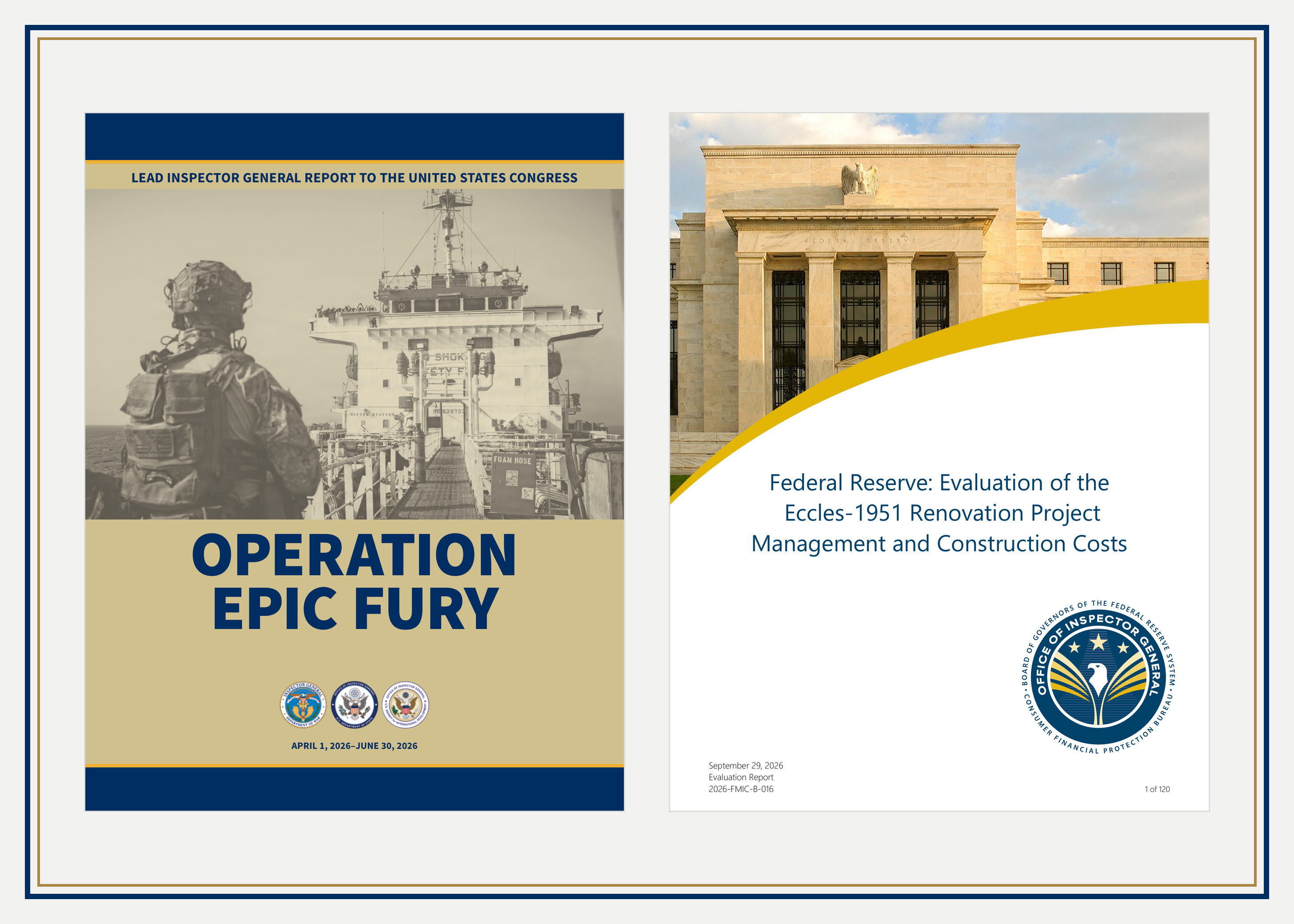
But the reality is more complicated. The IG corps across the government is, on the whole, diminished. And yet IGs can still facilitate executive branch accountability, as two recent IG reports—from the Trump-appointed, Senate-confirmed Pentagon IG, and the non-confirmed Federal Reserve IG—illustrate.
The Moring Report
A few weeks ago the IG of the Department of Defense, Platte Moring, together with two other IGs, issued a report on Operation Epic Fury (OEF), i.e., the Iran war. The report gathers facts about OEF from its inception on Feb. 28, 2026, through June 30, 2026. It contains information that the administration had withheld from the public and that contradicted its public narrative about important aspects of the war. Such revelations by Trump appointees weren’t supposed to happen in the unitary-executive-on-steroids.
The report reveals lots of previously undisclosed information related to the war, including the official scale and impact of base damage; damage to diplomatic structures; the extent of diplomatic disruption and evacuation; DOD’s uncertainty about “what its future posture will be in the region” in light of damage to its infrastructure there; and that the full OEF mission statement is classified.
The report also confirms (often with new detail) that Iran had “damaged and destroyed hundreds of buildings and structures at U.S. bases in Kuwait, Bahrain, Qatar, UAE, Saudi Arabia, Iraq, Oman, and Jordan,” and that the war’s estimated cost through June 29 was $33.4 billion. And it reaches beyond its reporting period to count four service members killed in July as Iran-war deaths, somewhat contrary to the administration’s official narrative, which puts their deaths in a separate “overseas operations” category.
Perhaps more important, the IG reported facts that challenge the veracity of the administration’s narrative about the war’s impact on U.S. military readiness.
Several officials, including Secretary of Defense Pete Hegseth, have in various ways denied news reports that OEF was causing a munitions and missile defense shortfall. The IG report, citing the Pentagon office responsible for acquisition and sustainment, stated to the contrary that “the munitions expenditure in OEF has resulted in strategic inventory shortfalls and revealed industrial base bottlenecks for munitions resupply.” President Trump called this claim “mostly fake news.”
The president and secretary of defense had also suggested that the weapons supply chain was keeping pace with the conflict. The IG report cites DOD acquisition experts to say that the “defense industrial base requires ‘significant lead time’ to expand production capacities” and that “persistent bottlenecks remain in the production of solid rocket motors, the availability of high-grade explosives and propellants, and the recruitment of skilled manufacturing labor.”
How and why did a DOD IG nominated by the president and endorsed by Hegseth extract and publish facts unavailable to the public (and likely Congress) that suggest that the president and secretary of defense misled the American people about aspects of the war they started?
The short answer: Congress required it.
The law, 5 U.S.C § 419, originated in Section 848 of the 2013 National Defense Authorization Act (NDAA) and was expanded in the 2020 NDAA. It seeks to keep Congress abreast of the cost and progress of “overseas contingency operations” (OCOs), like OEF, that last more than 60 days. Section 419 in this circumstance requires the chair of the Council of the Inspectors General on Integrity and Efficiency to designate a lead IG from among the DOD, State Department, and USAID IGs to develop a “joint strategic plan” and a quarterly report. IGs have been issuing quarterly reports about OCOs for over a decade.
Trump went on a rant about these IG war reports in his first term, in 2019, and told Acting Secretary of Defense Patrick Shanahan to stop them. Then-Acting DOD IG Glenn Fine—a respected former DOJ IG—told senior DOD officials that he had a statutory duty to write and publish the reports and that he planned to continue to do so. And he did subsequently issue several such reports over the next year despite the president’s directive to Shanahan.
The White House later pushed Fine out after he was selected by his fellow IGs to chair the Pandemic Response Accountability Committee. Yet the OCO reports continued without interruption through the end of Trump 1.0 and the Biden administration, right up through Moring’s report a few weeks ago.
Why did the Trump administration tolerate Moring’s report? Trump has fired over 20 IGs and could have fired Moring before or upon issuance of the report. And Hegseth, who knew about the report long before it was published, could have taken steps to slow it. He might have invoked his statutory authority over the DOD IG to stop Moring from issuing the report or to cut off his access to DOD components on national security grounds. But that authority’s applicability in this context is contestable, and if he had exercised it, both he and the IG would have needed to report on the matter to Congress. He or the president also might have invoked the unitary executive principles in Slaughter or Trump v. U.S. to check Moring in various ways regardless of what the IG Act says.
I suspect the administration perceived that firing or slowing the Trump-nominated and Senate-confirmed Moring over a report about a controversial war in election season would have cost them much more politically than letting the report go forward. The report showed Trump and Hegseth, and the administration more generally, to be shading the truth on the war. But that was not huge news. Amid the bombardment of daily and hourly Trump outrages it barely registered a blip on the public radar. Trying to stop or slow Moring almost certainly would have been bigger news, and a bigger problem for the administration.
Then there is the question of Moring’s thinking. He has an admirable history of public service, including a stint as a lawyer in DOD in Trump 1.0. And he pledged independence at his confirmation hearing. We don’t know how vigorously he pursued the OEF matter or what he might have left out of the report. But he appears to have discharged his statutory duty. In Trump 2.0, and given the report’s contents, that is striking.
The Horowitz Evaluation
Last week, the Federal Reserve IG, former DOJ IG Michael Horowitz, issued an evaluation that found project-management and cost-control failures in the renovation of the Fed’s headquarters buildings but no reportable criminal conduct by then-Fed Chair (and now Fed Governor) Jerome H. Powell or anyone else.* Last Friday, Attorney General Todd Blanche said the Justice Department would not reopen the criminal investigation of Powell that it had closed last spring.
Recall that throughout 2025 President Trump attacked Powell and threatened to fire him. In June, Powell’s testimony to Congress included comments on the building renovations which over the next few weeks drew accusations of deception and illegality from senior executive branch officials. By mid-July Trump was considering using renovation overruns as a ground for dismissal. Powell around this time asked Horowitz to review the renovation project. In November, D.C. U.S. Attorney Jeanine Pirro opened a criminal investigation, and two months later she issued grand jury subpoenas related to Powell’s testimony. Two months after that, Chief Judge James Boasberg quashed the subpoenas on the ground that their dominant purpose was to pressure Powell.
But Pirro’s investigation continued. So did Horowitz’s evaluation. On April 16, 2026, Pirro’s office, at its request, met with Horowitz’s team about the evaluation. As late as April 22, she said she would continue the investigation. And then on April 24, Pirro announced that her office had closed the criminal probe “as the [inspector general] undertakes [his] inquiry.” She added that she would “not hesitate to restart a criminal investigation should the facts warrant doing so.”
The dominant explanation for the Pirro turnaround is surely that the administration wanted Senator Thom Tillis to lift the hold he had imposed on Kevin Warsh’s confirmation as Federal Reserve chair, which Tillis pledged to maintain as long as Powell was under criminal investigation. It is possible that the Horowitz meeting contributed to Pirro’s decision. Since the final evaluation stated that “at no point” did it find “reasonable grounds to believe that a violation of federal criminal law had occurred,” the Horowitz team may have conveyed information on this point in April. (The evaluation states that the Fed IG team “described the scope and status of our evaluation” at the Apr. 16 meeting.)
Though the Fed IG evaluation found no grounds to report criminal activity, it was very critical of the Board for failing to manage its main construction contract and for weak internal governance. Warsh, now confirmed as Fed chairman, accepted the findings and recommendations in the evaluation. In a Truth Social post excoriating Powell, Trump said that he had asked Blanche to look at the evaluation and decide what to do. Blanche was satisfied enough with Horowitz’s conclusions not to reopen the investigation—even though the Warsh-confirmation reason for the April closure is moot.
Beyond its possible impact on Powell, the evaluation did something neither the Fed nor Congress had managed to do: it gathered and published detailed information about the causes of the massive cost overruns in the Fed building project. The evaluation documents what went wrong and suggests how to avoid problems in the future. Other agencies and Congress may be inspired by its seventh recommendation about “a standardized framework and agency policy for planning and overseeing future significant initiatives.”
Lessons
These IG reports illustrate what IGs do best in the right circumstances: they uncover facts about executive branch practices that other institutions inside and outside the executive branch can’t or won’t; they report them as credibly and objectively as Washington culture allows; and, when appropriate, they make recommendations about how to fix the problems they uncover.
I don’t want to overdraw lessons from these two events. Neither IG matter involved a Trump-appointed IG initiating an adversarial inquiry that threatened the administration in a serious way. And as a general matter the Trump administration has succeeded in chilling most IGs around the government from robustly pursuing abuse and fraud within their agencies.
And yet, I think, both events are important. Absent the existence of the IGs at the Fed and DOD, the public almost certainly would not have the important information that the IGs gathered and disclosed. And both IGs were able to do so inside the maximalist, Slaughter-approved unitary executive.
One can walk through the Inspector General Act and find many IG authorities that are hard to square with Slaughter or Trump v. U.S. But IGs have general support on both sides of the aisle in Congress since both parties benefit, in the long run, from being able to call on IGs and learn from them about executive branch activity.
These two episodes raise the question how much the formal unitary executive matters to IG efficacy. IGs remain useful to many actors inside the executive branch and in Congress, and that usefulness can empower them politically even if they lack formal independence within the executive branch.**
* I am teaching a seminar this term with Fed IG Michael Horowitz on “Independent Oversight Within the Federal Government.” I have not discussed with him his evaluation and I did not consult him in writing this essay.
** Pursuant to statute, Horowitz was appointed by Chairman Powell and is removable with the concurrence of two-thirds of the Board of Governors. His formal independence from the president depends on how broadly one reads Slaughter in light of the statute’s assignment of removal to the Board, the Court’s special treatment of the Fed in Cook, and Horowitz’s likely inferior-officer status.