


Please click here to opt in to receive via email our Roundup—brief daily summaries of news developments and commentary related to executive power.
When the Supreme Court issued its decision on presidential immunity, Donald Trump applauded the outcome as a “BIG WIN” for the country and Constitution that made him “PROUD TO BE AN AMERICAN.” He had earlier praised the Court for taking the case up, arguing that “[p]residents will always be concerned, and even paralyzed, by the prospect of wrongful prosecution and retaliation after they leave office” and that they will also face “extortion and blackmail” in a weaponized criminal justice process.
But the story of the Court’s engagement with presidential immunity in the Trump era is not complete. Whatever else the decision means, the immunity decision does not protect the president from the legal consequences of private business pursuits. Trump cannot count on immunity from the public corruption issues raised by the billions of dollars he has amassed in office through activities with no plausible connection to his “official” duties.
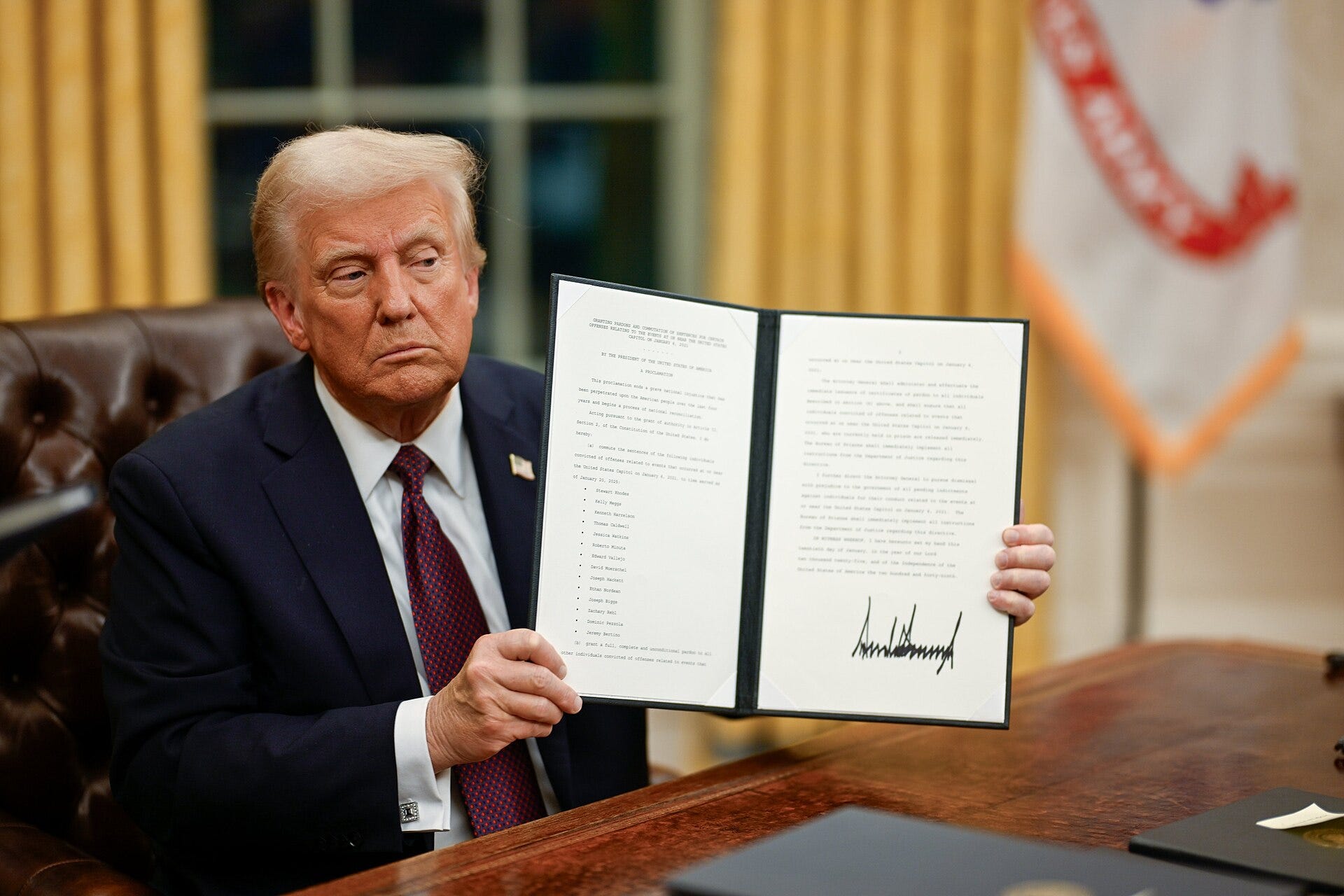
One solution to this problem for Trump is a self-pardon, which he has declared in the past that a “couple of attorneys” advised him he could do. If Trump eventually pardons himself and faces a criminal investigation, the Supreme Court will almost certainly have to resolve its validity. The circumstances in which the issue is presented to the Court will have some bearing on how it appreciates the stakes. An investigation or prosecution will inevitably seek to frame the case as devoid of politics: straight corruption, entirely private in character. Trump will strive to replace this framing with that of “weaponization,” which is all about politics.
Should Democrats win control of at least one house of Congress, they will have to keep these competing narratives in mind as they seek in hearings or investigations to hold Trump accountable. How they structure and present the case against Trump’s self-enrichment in office could influence the outcome of a constitutional test of the self-pardon. In concrete circumstances, the Court will have to weigh the competing concerns: a toxic politics practiced with crippling effects on the presidency, or full immunity for presidents that encompasses private acts of self-enrichment in office.
Since the Court stressed in Trump v. United States that “the President is not above the law” and that its immunity decision should not be read to the contrary, one might think it would be heavily disposed against a self-pardon. However, the constitutional sources of immunity at issue here are different. For the purposes of the immunity decision, a president’s pursuit of personal business interests fall clearly on the “unofficial” side of the line that the Court drew to separate out private acts for which immunity was not available. In the very different case testing the constitutionality of the self-pardon, the private/official distinction is irrelevant.
Scholars of the pardon power, like Sai Prakash and Paul Larkin, who are divided on the constitutionality of a self-pardon, agree that the matter is unsettled. But it is striking that in his recent study of the pardon power, Prakash writes that while he is not “comfortable” with a constitutional conclusion in support of self-pardons, he can nonetheless “imagine situations where many might think it entirely justified.” He posits a situation in which “a departing president feels that he is not guilty of violating any law” but “is certain that he will be prosecuted, a trial which will be bad for him and terrible for the country.” The president in Prakash’s hypothetical is “sincere,” and critics of Trump will respond that the hypothetical does not fit with the likely facts and motives in this president’s particular case. Trump’s most ardent supporters are sure to disagree. The point is that the Court could go either way.
It is impossible to say how much of a difference the strategies of accountability in the political process will make in the course of this constitutional adjudication. But the justices will decide the question of self-pardon against the background of sharp differences in opinion over the political motives at play and their implications. It is hard to see that the constitutional judgment will be unaffected by how the issue develops outside the judicial process before it arrives at the Court. The challenge for Congress will be to establish a clear and overriding concern with the rule of law while blunting the claim Trump is certain to advance that the purported accountability is a sham, shaped to lay the groundwork for successful criminal prosecution.
One path is for Congress to focus on building a robust factual record tied to the purposes of legislative reform. Reform initiatives could include what should be relatively non-controversial transparency measures, such as a requirement that the president produce tax returns. The case for requiring presidents to establish truly blind trusts, with independent management and congressional oversight, could be strengthened. Congress could take steps toward improving on the lamentably inadequate exercise of its power to prevent presidents’ receipt of benefits or payments from foreign governments in violation of the Foreign Emoluments Clause.
Adopting this course does not imply that Trump somehow just exploited loopholes, successfully gaming the law but not actually violating it. It serves more to enable Congress to counter the “weaponization” framing that Trump will seek to impose on the process, which he has made clear will be his justification for a self-pardon. While making the case for reform, Congress would painstakingly document how no president before Trump has so aggressively and flagrantly monetized his office. To the extent possible in any congressional (political) process, the facts—many already on the public record, but with much more to be uncovered—would be given room to speak for themselves. Given the certainty of a self-pardon, which Trump will defend as necessary protection from a vengeful opposition, an effective message will be that the process has been set up to “get the facts,” not so much to “get Trump.”
I say “to the extent possible” because we are operating in a world in which the president and his allies will undoubtedly go on the attack with mis- and dis-information. Voices among Trump’s opposition are also sure to escalate quickly to calls for impeachment and for fact-finding primarily as a prelude to criminal prosecution after Trump leaves office. It is sure to be a messy, polarizing process.
I am not suggesting that the potential effects of a self-pardon override all other considerations in how Democrats manage this messiness or respond to what its fact-finding may uncover. This much, however, is probable if not certain: Trump will pardon himself. He has already launched a quest for protection from tax liability issues with the sham settlement of his suit against the IRS. If Trump is concerned about his liability under the Internal Revenue Code, he is doubtless attentive to other risks he is running with his program of self-enrichment. A self-pardon is a natural, inevitable sequel. We should take seriously reports that Trump has told aides he will pardon everyone who comes within 200 feet of the Oval Office. He will not leave out the one who actually sits in that office. (And for whatever it is worth, which will not be much in the courts, it is likely that his Department of Justice’s Office of Legal Counsel will issue an opinion to validate self-pardons, reversing the thinly reasoned judgment it issued in 1974).
Maximizing the chances that a self-pardon fails in an eventual judicial test is an essential element in addressing this president’s legacy of self-enrichment. In holding him accountable, as it should, Congress has political choices that could make a difference. An exercise in accountability for Donald Trump’s profiteering in office that ends in a self-pardon upheld by the Supreme Court will not count as a success.
