


Please click here to opt in to receive via email our Roundup—brief daily summaries of news developments and commentary related to executive power.
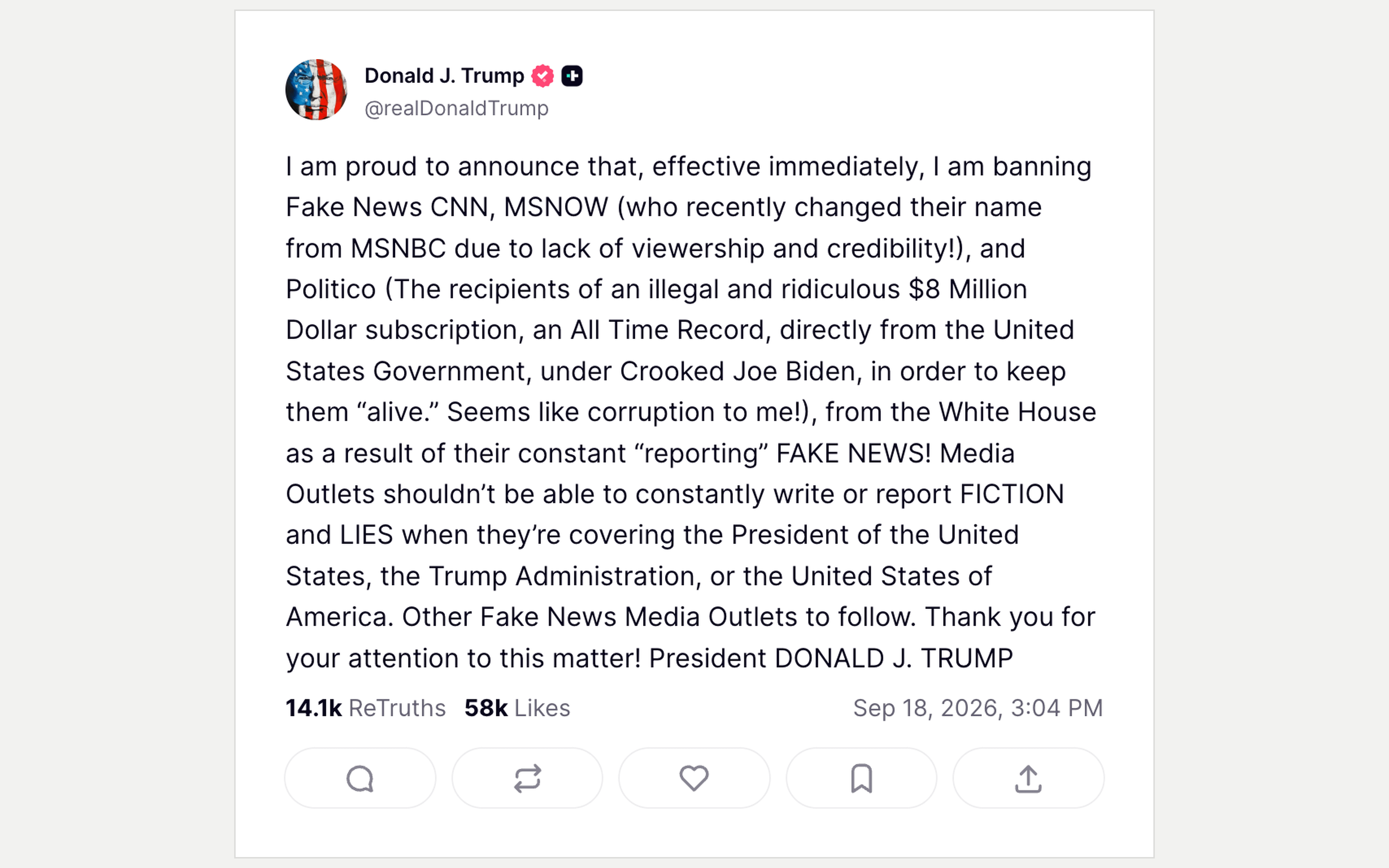
This week three press organizations sued to enjoin President Trump’s ban on their access to White House grounds and the briefing room. The network press pool then suspended its activity in an act of solidarity and protest. In this posting, I would like to address one aspect of the Trump administration’s war on the press that connects to another, ostensibly unrelated recent development: Attorney General Todd Blanche’s extraordinary involvement in midterm political campaign activity, such as his speech to the Republican National Committee’s midterm convention in Dallas and his appearances at campaign rallies.
On first look, the dissimilarity of the two developments may seem clearer than any connection. The administration’s press ban raises major constitutional questions about a president’s power to restrict unfavorable, or coerce more favorable, media coverage. Any legal question the AG faces arises under the Hatch Act restrictions on campaign activities by executive branch officials and employees. Unlike the constitutional challenge to the press ban now before the courts, the Hatch Act questions have received little attention, likely because, as noted below, no one has any reason to believe that much will come of them. What is left is the Attorney General’s breach of a norm—as Charlie Savage wrote, the “dismantling [of] another post-Watergate principle: that Justice Department leaders stay away from partisan politicking.” This would not strike many observers as a new development.
But both episodes reflect, in different ways, Trump’s exercise of presidential power to achieve maximum control of the information environment. The press ban, and Trump’s other assaults on the press, serve to keep unwanted speech from impeding the effectiveness of presidential communications. The mobilization of the AG and other senior officials to support campaign activities reflects a whole-of-government approach to getting those messages out. The constitutional issues complicate the first objective; the Hatch Act presents a challenge, more easily ignored, to the second.
Trump and the Press
Administrations before this one have shared the intense preoccupation with getting “good,” and limiting “bad,” press. As Jack and I have written, “The press presents more than an obstacle, or asset, to be shaped in the service of reelection. It also impacts the president’s capacity to manage public opinion in support of a governing program.” Good press aids the governing objectives of a president. Bad press undermines them.
Yet it was clear already in his first term that, while Trump was “not the first president to see the press as more ‘enemy’ than rival: out to get him,” he was unrivaled in his “rhetoric and centrality of press animus to his political program.” Trump has since his first term moved more aggressively toward the goal of limiting bad press than even the most militant of press-antagonistic presidents before him, Richard Nixon. Nixon’s war on the press was extraordinary for the times. It prompted the National Press Club to issue in 1973 a formal public report, accusing the administration of a “policy of massive official hostility” toward the news media. Both Nixon and Trump displayed acute personal paranoia about the press and sensitivity to bad coverage. Both utilized various means of retaliation and suppression, including high-pitched rhetorical attacks on the press’s credibility and resort to the abuse of official power, including enlisting the Federal Communications Commission in a campaign of intimidation. Trump has innovated, filing multibillion-dollar lawsuits against major press organizations over what he deems “fake news” coverage.
Trump’s conception of his office and its powers has lent extraordinary force and direction to this confrontation with the media. He sees no reason—certainly not in law or norms—to give any quarter to a critical press. He is taking to the limit the view that he should have unfiltered channels of communication with the public and the ability to shape an information environment that most effectively supports his message. In his first term, he sought to characterize his Twitter account as “personal” rather than “official,” enabling him to block unwanted users from a communications channel that he acknowledged as a means to “challenge media organizations whose coverage of his Administration he believe[d] to be unfair.” This move failed in court. With the ban on critical news media organizations, Trump is now taking to a wholly new, heightened level his drive to block interference with his messaging to the public.
Blanche on the Campaign Trail
It is not surprising that, in managing this information environment, Trump would also put to use any and all of the assets at his disposal, including his senior aides and officials. If he does not, as he doesn’t, see the Department of Justice as independent, and hence is indifferent to even the “appearance” of a politicized law-enforcement function, he will naturally call on the Attorney General to join in executing his communication strategy—even in support of partisan political messaging. If a president can direct the Attorney General in every respect, not to mention fire him for any disinclination to do as directed, he can demand that the Attorney General and any of his subordinates add their voices to Trump’s campaign appeals. Blanche has unapologetically answered the call: “I will always say yes to speak when the president of the United States asks me to.” By mobilizing Blanche, Trump can augment and reinforce messaging on favorite themes, like crime and immigration enforcement, that he and his party have been pushing in this campaign period.
As for the restrictions of the Hatch Act? The law’s purpose is to check partisan politics within the executive branch and protect the impartial administration of government, while allowing employees to engage off duty in the exercise of their constitutional rights of political participation. The law distinguishes “less restricted” employees from those who are “further restricted” because they serve in sensitive agencies, such as those in the intelligence community. The Attorney General is not among them. But binding on all is a prohibition on the use of “official authority or influence for the purpose of interfering with or affecting the result of an election.” This is a good-government measure, but it is also a restriction on partisan political speech by administration officials.
Under the Hatch Act, a Cabinet official like the Attorney General cannot in his official capacity engage in partisan political commentary or attend campaign events. Blanche and the White House deny for the record any Hatch Act violations, maintaining that he made his appearance at the Dallas convention in a personal and not official capacity. Ethics experts disagree. Joseph Tirrell, the former head of the DOJ ethics office, fired in 2025, notes that “[t]he Office of Special Counsel (OSC) has repeatedly made clear that a disclaimer cannot erase the use of official authority, information, or achievements for partisan purposes,” and that the “real question is simple: Would a reasonable person understand Blanche to be speaking as a private citizen or as the Attorney General of the United States?” He concludes that at least an investigation is warranted.
But there will be none. The law provides for the Special Counsel to bring enforcement cases to the Merit Systems Protection Board, except those involving Senate-confirmed officials, which are “presented to the President for appropriate action.” Trump, then, would decide what action (if any) to take. Blanche is safe. But the Attorney General would have no reason for worry in any event. The Trump administration in its first term made it clear that it had no intention of allowing the restrictions to affect the role of senior officials in political messaging. OSC had adopted the practice of referring to the president even complaints against White House staff in posts that did not require Senate confirmation. Senior advisor Kellyanne Conway repeatedly violated the limitation—“of a scale and severity never seen before”—prompting OSC to recommend to the president her termination. The White House took no action and further declined to make her available for congressional testimony on this issue. (In 2024, the then-head of OSC, Hampton Dellinger, announced that he would change OSC practice and bring Hatch Act complaints against White House staff to the MSPB rather than refer them to the president. Trump fired him less than a month after taking office for his second term.)
It is fair to note that the Biden administration also struggled with the Hatch Act speech limitations, finding itself at odds with OSC over the White House press secretary’s references to “MAGA Republicans.” But while the Biden White House counsel disagreed with OSC’s view that the use of the term was impermissibly political, the White House accepted it as the binding judgment of the Hatch Act’s enforcement authority. The Biden administration’s Department of Justice also imposed restrictions on even off-duty activities by political appointees, going beyond the law and seeking to invigorate the norm against politicized law enforcement in fact or appearance. In March of this year, Attorney General Bondi rescinded them.
Conclusion
The administration of an all-powerful president, as conceived and practiced by Donald Trump, does not accept opening the White House doors to any press organizations that would complicate or obstruct the delivery of his message. Critical reporting is “fake news” and “lies,” and this president is committed to deploying his entire government to combat it. Nor does Donald Trump accept limits on the resources he can muster, including the speech of government officials, to counter this threat to his communications priorities and strategies. In deploying these resources, he rejects the distinction between federal government speech on policy and its involvement in partisan political advocacy.
By Monday night, Trump responded to the intensifying conflict with the press by establishing an alternative news facility, “Trump TV: The Essentials Station.” We will see in the weeks to come whether Attorney General Blanche and other government officials may be directed to appear on this new outlet to address political as well as policy topics as November 3 approaches.