


Please click here to opt in to receive via email our Roundup—brief daily summaries of news developments and commentary related to executive power.
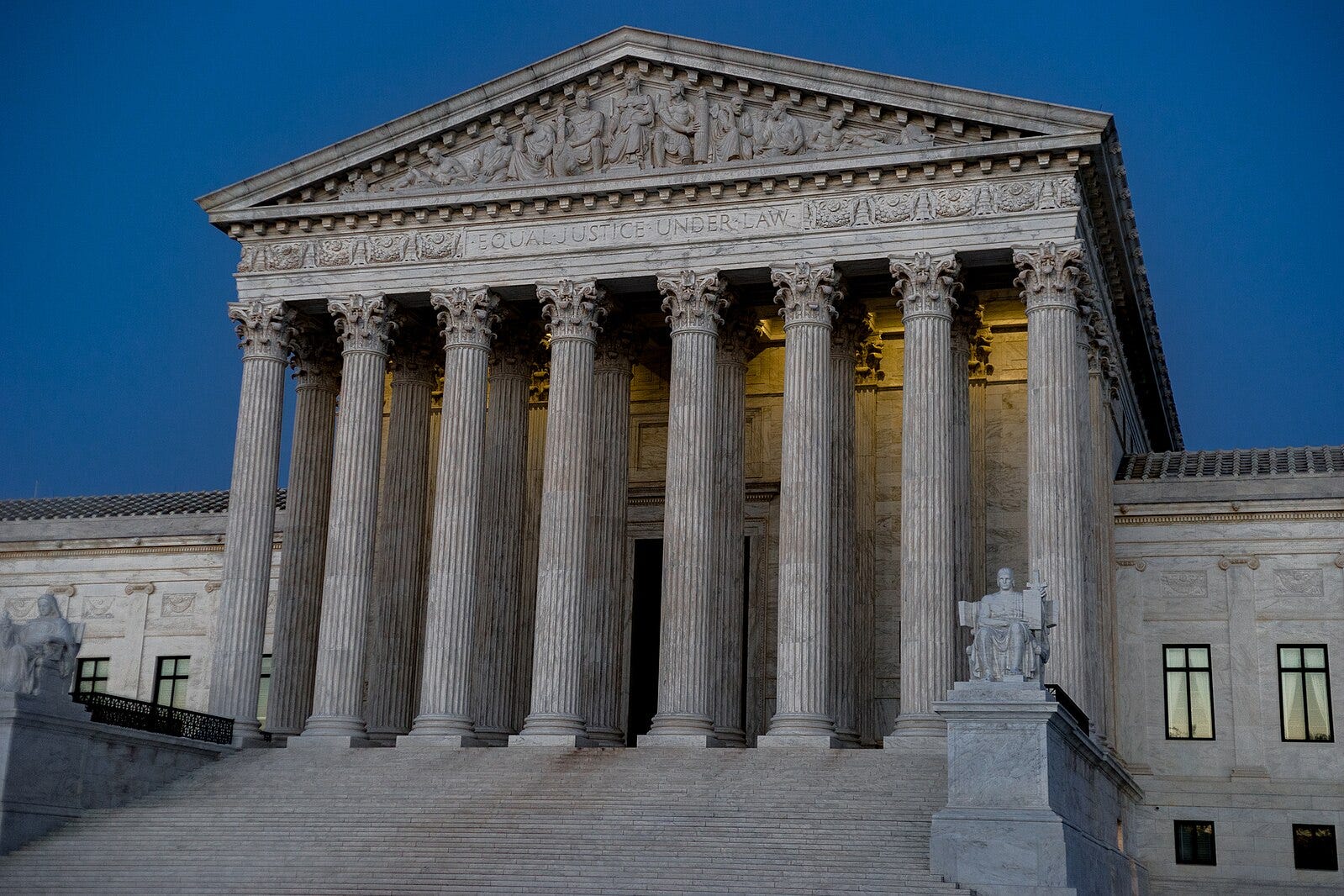

Will Baude wrote in the New York Times last week in defense of the Supreme Court, calling for celebration and not condemnation. Steve Vladeck responded the next day with condemnation, sharply criticizing Baude’s position. But Vladeck misses his mark in ways that illustrate challenges facing progressives in their critique of the Roberts Court and in devising a Court reform program that could attract wide support.
Unlike some progressives, Vladeck does not support “packing” the Court, i.e., adding seats to the Court that would be filled by Democratic nominees (we agree here: I favor term limits). As he lays out in a recent video chat with Jack, Vladeck would prefer a program of accountability to Congress that would confront the Court’s “hubris.” The problem, as he sees it, is that justices believe that they can “do whatever they want, whenever they want.” He proposes various measures, such as mandating jurisdiction over appeals, codifying standards of review, and appointing a Court Inspector General to aid in the enforcement of ethical standards. Vladeck’s goal is to restore “interbranch dynamic[s]” as a means of curbing “bad behavior” by the Court, and he claims that this critique reflects “structural objections” independent of his view of the correctness of its rulings.
Vladeck’s effort to identify a reform program that can rest on politically neutral, structural footing is a worthy project. But a close look at his response to Baude shows why, in two key respects, it does not succeed on these terms.
First, Vladeck’s critique seems to assume that his program would answer “public” loss of confidence in the Court, and that more public trust in the Court will follow from active congressional intervention.
Second, Vladeck declines to acknowledge the extent to which his dissatisfaction reflects unhappiness with the substance of conservative majority rulings. This is important to the extent that he wishes to advocate for a program that escapes the criticism that it really is an outcome-based quarrel with the Court, not just institutional reform. In short, how much of Vladeck’s program is a response to “bad behavior” and how much of it is a response to bad rulings?
Public Loss of Confidence and the Role of Congress
Vladeck suggests that the public, not only elites, has become disaffected with the Court. Certainly public opinion polls show a steep decline in public approval. But Vladeck then states that the content of the Court’s rulings, not just its “bad behavior,” “ha[s] galvanized public criticism of the Court.” Outcomes emerge, front and center, in his case for reform. And he is right about these reasons for the public’s critical engagement: it is exceedingly unlikely that the public criticism has been “galvanized” by concerns over the Court’s management of its emergency docket or any other purely “structural” issue.
But the question then is: how does Vladeck identify the “public” that he believes has been driven to disapproval of the Court’s performance, and in response to which rulings? I’m highly suspicious of arguments keyed to apparent public judgments that are molded (and no less significant for that) by the politics of the moment. Advocates for particular public policies frequently cite the “people” or the “public” as their allies. So do their opponents.
It is thus curious that in answering this public and elite disaffection with the Court, Vladeck would repose significant responsibility for Court reform in . . . Congress. How he imagines that the public is prepared to match that confidence is mysterious. Approval of Congress barely breaks into double digits. And the partisanship that has infected that institution—the problem of a “separation of parties, not powers”—does not easily position it to champion reform that is attractive or acceptable across the political divide.
Public Confidence and Court Ethics
Vladeck is frustrated with Baude’s downplaying of complaints about the Court’s ethics and his skepticism about what ethics reforms would accomplish. The Court’s posture on ethical standards, transparency, and enforcement is unquestionably a fit subject for critical comment. My view is that the Court long ago should have adopted in clear terms an ethics code. I also think there is a strong case for reform barring justices from holding and trading in individual stocks, a proposed reform that President Biden’s Supreme Court Commission noted has drawn wide support among commentators.
But I also think that there are two misguided paths that Court ethics reform arguments can travel, and Vladeck takes both.
One is the error in imagining that the Court’s image or public standing will be addressed by some kind of process reform. Studies of good government reform in other contexts show that that is not the case: process reform does not bolster public confidence; government efficacy does, as do the election results voters want. If the public is happy with the Court’s performance, it will not be overly troubled by justices’ ethics. (We see the same connection on display in the electorate’s conclusion that Donald Trump’s massive grift in office is unacceptable—now that he has failed to build “the greatest economy” in the history of the world but has done quite well for himself and his family.)
And I think that Vladeck makes a fundamental mistake when he says that whatever the reality of the justices’ ethics may be, the appearance of impropriety “often . . . does just as much damage to public faith in the judiciary as any impropriety itself.” The appearance standard has played a mischievous role in reform projects for as long as I have studied them. Appearances vary with the beholders. Very often, the allegation of an “appearance” problem is motivated by, or a proxy for, a substantive objection. The insistent allegations of an “appearance problem” can also be a source, maybe the principal source, of a growing perception that there is an appearance problem. Far better to identify a concrete issue, such as stock trading, and address that, than to build reform on contestable claims about appearances.
A Critique of Outcomes, Not of the Institution
Vladeck takes strong issue with Baude’s criticism of the left’s lack of perspective on the Court’s performance in Trump 2.0. Baude questions how progressive critics can so heavily discount the significant cases the administration lost in the past year: tariffs, birthright citizenship, misuse of the National Guard, and election law cases. It is revealing that Vladeck answers the challenge by refusing to take satisfaction in rulings that he should like, because of his strong objection to others he dislikes. As he puts it, “we don’t owe thanks to John Roberts for raising the chocolate ration to twenty grams a week when it was only yesterday that he lowered it to that level.” In making his point, he cites specific decisions: Citizens United (which “opened the spigots on money in our elections”), the decisions weakening the Voting Rights Act, and the Court’s performance in redistricting cases.
I, too, have quarrels with the VRA decisions. But by lumping these three categories together, Vladeck does not account for significant differences that, in my opinion, should be accounted for in any assessment of the Roberts Court’s performance. And the difference lies in Vladeck’s priors. He objects to the Court’s failure to rule in a manner compatible with his policy preferences; his concern here is not “structural,” but instead about outcomes.
To take one example, Vladeck suggests that Citizens United somehow accounts for the role of money in politics. He reasonably sees the torrents of political spending as a major policy issue, and he has concluded that the Court is responsible. Citizens United may well have made matters worse if one is concerned about these trends and believes that they can be reversed. At the same time, the citation to that case as somehow foundational, and to the Roberts Court as uniquely culpable, in the matter of money in politics is misplaced.
Complaints about the level of political spending and its effects have echoed throughout the decades. Citizens United did not somehow kill off the 1970s campaign finance reforms and the Congress’s intended repair in McCain-Feingold; those reforms collapsed for various reasons, of which the Court’s jurisprudence is only one. Both parties actively and creatively resisted limits on what they took to be necessary to win elections—especially as electoral competition became fierce in a hyperpolarized politics and losing came to be seen as intolerable. The failures of the campaign finance regulatory regime became evident well before the Court in 2010 decided Citizens United. And long before John Roberts arrived on the scene, the Rehnquist and Burger Courts helped lay the foundation—all the way back to the truly foundational 1976 case, Buckley v. Valeo, where the Court fatefully linked campaign spending to rights of free speech and association. Vladeck is concerned on this topic not with “hubris,” but with the Court’s campaign finance jurisprudence.
Consider, too, Vladeck’s objection to the Court’s decision to abstain from judging what constitutes constitutionally impermissible “partisan” gerrymandering. The Court had kept open the possibility of intervention for some time while it wrestled with what standards it would apply, then concluded that it should give up the chase. Maybe it should have given up, maybe it should not have. But Vladeck has difficulty squaring his profound suspicion of the ideological motivation behind the Roberts Court’s decisions with his wish that the Court should set itself up to intrude aggressively into political conflicts within state legislatures over drawing district lines. Again, an objectionable jurisprudence, not hubris or some other institutional failing, is the basis for Vladeck’s charge against the Court on this issue.
Finally, I note Vladeck’s claim that Roberts, in the election law cases, deserves “exactly the same credit we might give to the arsonist who shows up with a fire extinguisher.” I am not sure what to make of this argument. Vladeck clearly would not have responded favorably had the Court given the green light to the lawless, last-minute interventions in the midterms attempted by the administration as its political position around the country crumbled. Had he been given the choice at the time, it seems clear that he would have called for the fire extinguisher. Arguments about the allocation of “credit” for putting out the fire don’t seem to serve much purpose other than to underscore his objections to Roberts Court jurisprudence.
Also striking is the degree to which Vladeck would deny credit to the Roberts Court for turning away these interventions. He was horrified that when the Court rebuffed the administration’s attempt, in these midterm elections, to convert the Postal Service into an election mail monitor, Alito and Thomas dissented. I do not know how Roberts, whom Vladeck charges with “responsibility” for all the bad rulings he cites, could be held accountable (any more than other members of the Court) for the dissents registered by Alito and Thomas in a case in which the Chief Justice voted the other way.
Conclusion: Celebration, Condemnation, and Critique
As the Supreme Court Commission noted in its review of the history of conflicts over the Court, “debates about the proper role of the Supreme Court are as old as the Constitution.” From the beginning—Marbury v. Madison is certainly hubristic—the question of this institutional “hubris” has been consistently at the center of objections to how justices have performed their roles. Progressives (then “liberals”) celebrated this hubris in the case of the Warren Court but lost patience with it when the conservatives came into the majority. They applaud justices appointed by Democrats for taking preferred policy into account in deciding cases, often because they share those preferences; and they are less charitable about consequence-centered judging on the other side of the ideological divide. And vice versa.
This is only natural. And it is not always unreasonable or contrary to rule-of-law values for the Court to look beyond the most rigidly formal application of doctrine—or to be urged to look beyond it—to real-world effects in a particular case. The stubborn problem is that observers have very different views of when it should do so and what effects the justices should be concerned with. This is, of course, why nominating battles have become bitterly contentious.
The task is not to choose between celebration and condemnation, but to find the critique likely to be most persuasive to the largest possible audience for institutional reform. Two reforms I have cited—term limits and the ban across branches on individual stockholding and trading by elected officials and justices—are just two examples of major changes, each structural in nature, that could not be fairly tied to their advocates’ preferences for particular case outcomes. Vladeck argues in principle for structural reforms, but the fine print of his response to Will Baude reveals other concerns and goals.
Note: I was co-chair of President Biden’s Commission on the Supreme Court, Will Baude was a Commission member, and Steve Vladeck provided expert testimony.